Picture a calm week on the Nifty, the index drifting inside a tight band while two option sellers wait for time to do the work. A short strangle is that wait turned into a position: sell a call some distance above the market, sell a put some distance below it, and pocket both premiums on the view that the index finishes the expiry somewhere between the two strikes. On a quiet stretch, the trade prints small gains in slow, satisfying steps.
That quiet is the whole bet, and it is also the whole danger. The most a short strangle can ever make is the premium collected at the start. What it can lose is not capped at all. If the index runs hard in either direction, the loss on the breached leg keeps growing while the premium that felt like income turns into a deposit against a much larger bill. The strangle is one of the cleanest ways to sell volatility, and one of the easiest ways to confuse a run of good weeks with an edge.
This guide walks the full path in three steps, build, then backtest, then validate, and treats every rule, strike, and setting as a hypothesis to test rather than advice to follow. Because this rule sells options for a living, the validation step is not just the most useful; it is the one that drags the hidden loss into the light before real money meets it.
The strangle is one of the cleanest ways to sell volatility, and one of the easiest ways to confuse a run of good weeks with an edge.What a short strangle is and how its legs are structured
A short strangle is two options sold at once on the same underlying and the same expiry, at different strikes. The Options Industry Council defines it as "selling a call and selling a put with the same expiration, but where the call strike price is above the put strike price", with both options typically out of the money when the position is opened. Out of the money means the strike sits away from the current price, so the option has no intrinsic value yet. The seller collects a premium on each leg and keeps the lot if the index stays calm.
The payoff is asymmetric in a way that decides everything else. Maximum profit is limited to the net premium received, earned when the index finishes between the two strikes and both options expire worthless. The breakevens, per the same reference, are the call strike plus the total premium received on the upside, and the put strike minus the total premium received on the downside. The maximum loss is the part that matters most: the Options Industry Council states plainly that for a short strangle "the maximum loss is unlimited", rising without bound if the index climbs toward infinity on the call side, and becoming very large on the put side as the index falls toward zero. This is an undefined-risk position. The premium is the ceiling on the reward and there is no floor under the loss. Figure 1 shows the shape.
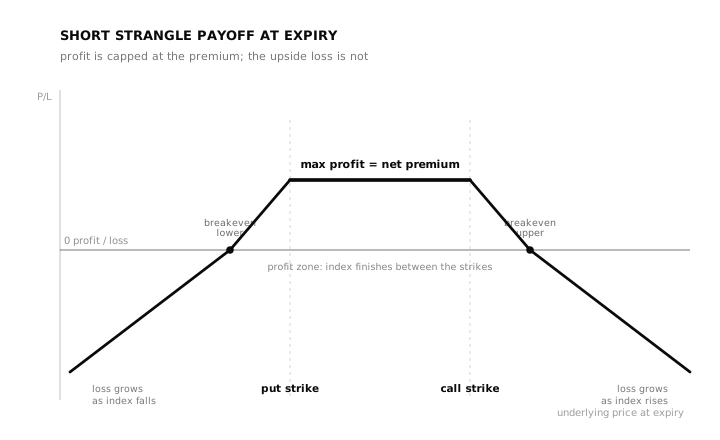
Figure 1: The short strangle pays a flat maximum profit, the net premium, only while the index finishes between the strikes. Past the breakevens, the loss is theoretically unlimited on the call side and becomes very large on the put side as the underlying falls toward zero. Illustrative figures.
The strangle is the wider cousin of the short straddle, which the Options Industry Council describes as selling a call and a put at the same strike. The straddle collects a larger premium but has a single profit point and tight breakevens. The strangle steps both strikes out of the money, trading a smaller premium for a wider profit zone and wider breakevens, room for the index to wander before the position hurts. Both are short-volatility trades. They profit when implied volatility, the market's expectation of future movement priced into option premiums, eases off, and the same reference warns that for a short strangle "an increase in implied volatility, all other things equal, would have a very negative impact on this strategy", even if the index itself does not move.
It is worth naming the mirror image. A long strangle buys an out-of-the-money call and an out-of-the-money put, and its risk profile is the exact inverse: the Options Industry Council puts its maximum loss at the "net premium paid" and its maximum gain as unlimited, a long-volatility bet that the index breaks sharply one way or the other. The short strangle in this guide is the seller's side of that trade, and it carries the seller's open-ended risk.
Building the short strangle as a no-code rule set
A trading rule is a fully specified instruction with no room left for judgement, and a strangle converts into one cleanly. The skeleton needs five decisions, each a hypothesis rather than a setting handed down as fact. The legs are fixed: sell one call above the market and one put below it on the same expiry. The strike distance is the first real choice, usually expressed as a fixed number of points from the spot, a percentage, or a target option delta, the sensitivity of an option's price to a move in the underlying, often used as a rough proxy for the chance the strike is breached. Wider strikes collect less and are breached less often; tighter strikes collect more and sit closer to danger.
The expiry is the next choice. Weekly options decay fastest in their final days, which is why many strangle rules open near the start of an expiry and close at or before it, but a shorter clock also leaves less room to react to a move. Then come entry and exit. Entry can be a fixed time of day, a volatility condition such as opening only when implied volatility is rich, or an index-range filter. The exit is where an undefined-risk rule lives or dies: a profit target as a fraction of the premium, a stop-loss expressed as a multiple of the credit received, a time-based square-off, or an adjustment that rolls a threatened leg. A strangle without a predefined stop is a strangle relying on hope, and hope is not a rule.
A strangle without a predefined stop is a strangle relying on hope, and hope is not a rule.Each of these dials is a separate experiment with its own risk, and none is correct in the abstract. A 0.15-delta strangle and a 0.30-delta strangle are different strategies, not the same strategy tuned. The same is true of a one-times-credit stop versus a two-times-credit stop, or a Monday entry versus a Thursday one. The job at this stage is not to pick the winner by argument. It is to specify each variant precisely enough that a backtest can judge it, then let the test do the judging.
How to backtest a short strangle honestly
A backtest replays a rule against historical data and reports what it would have done, the exercise the CFA Institute frames as estimating "how would this strategy have performed if it were implemented in the past." For a strangle that means reconstructing both option legs at every step from historical chain prices, opening and closing them on the rule's conditions, and recording every entry, exit, and the running account balance.
Costs come first, and on a strangle they bite twice. Every entry and exit is two legs, not one, so each round trip pays brokerage on both, the securities transaction tax, exchange and regulatory charges, GST, and slippage, the gap between the price the rule wanted and the price it got. These are charged on the premium, a small fraction of the notional the position controls, so a cost that looks trivial against the position is large against the credit that changes hands. The figure is gross until the costs are charged; only then is it a number you can read.
Liquidity is the quieter trap, specific to strangles because the strategy lives out of the money by design. Near the money, strikes are deep and tight. Step away, where a strangle sells, and an option can trade thinly, with a wide bid-ask spread and stale prices. Assume you sell at the bid and buy back at the ask, never at the mid, and on far strikes assume worse, because a backtest that fills on strikes that barely traded is trading prices that were never really available. Single-stock options add one more wrinkle: they are physically settled, so an in-the-money short leg held to expiry can become an assignment, an obligation to deliver or take delivery of the actual shares, rather than a tidy cash adjustment.
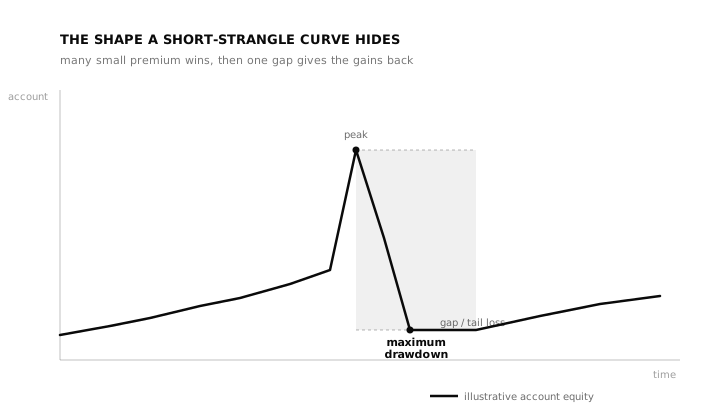
Figure 2: A short-strangle equity curve is deceptive by shape. It climbs in many small premium wins, then gives a chunk back in one gap, so the average week flatters the rule and the worst week defines it. Illustrative figures.
The metrics come in pairs of reward and pain, and for an option-selling rule the pain side decides everything. A high win rate, the share of trades that finish in profit, is the most misleading number a strangle can produce, because the strategy is built to win often and lose big. It can win nine expiries in ten and lose more on the tenth than it made on the other nine. That is why expectancy, the average outcome per trade after costs, is the honest summary, and why the maximum drawdown, the largest peak-to-trough fall in the account, matters more than the headline return. As Figure 2 shows, a short-premium curve rises in small steps and falls in one, so the worst single trade, not the average, is the number that tells the truth.
The figure is gross until the costs are charged; only then is it a number you can read.How to validate a short strangle
Validation is the step that separates a real edge from a flattering run of calm weeks, and it is the reason a single good backtest proves almost nothing. A strangle has only a handful of dials, the strike distance, the expiry, the entry, the stop, which makes it easy to sweep dozens of combinations and keep the one with the prettiest historical curve. That is precisely how a rule gets fitted to the noise of one stretch of history, a trap called overfitting. Marcos López de Prado, in Advances in Financial Machine Learning, shows that the more configurations you test, the more likely the best one is luck rather than skill. The winner of a parameter sweep is the most overfit setting in the set, not the most trustworthy.
The tests built to catch that self-deception come in a sequence. The first is out-of-sample testing: hold back a slice of expiries the tuning never touches, fit the parameters on the rest, then test once on the untouched slice. A rule that survives data it has never seen is more believable than one measured on the data it was tuned to. The stronger version is walk-forward analysis, which rolls that split forward through time, repeatedly tuning on one window and testing on the next unseen one, so the rule has to keep working as volatility regimes change rather than having worked once. For a short-volatility strategy this matters doubly, because the calm market that rewards premium selling can turn without warning, and a strangle tuned on a placid year is tuned on the wrong year.
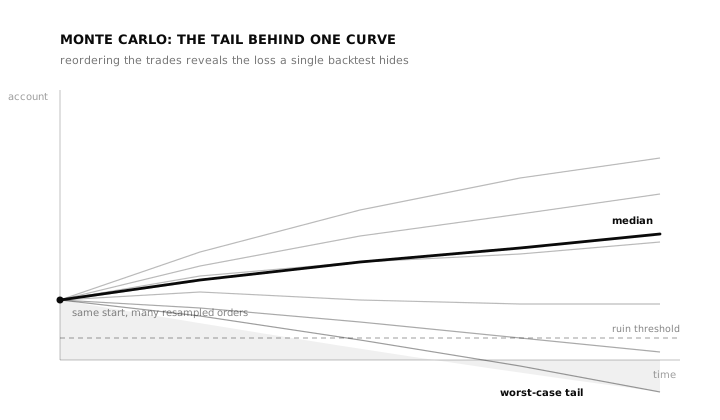
Figure 3: Monte Carlo resampling reorders the trades thousands of times to show the spread of outcomes one backtest could have produced. For a short strangle the lower tail, not the median, is the number that matters. Illustrative figures.
The test that earns its keep most on this strategy is the Monte Carlo simulation, shown in Figure 3, which resamples or reorders the trade sequence thousands of times to reveal the range of outcomes the rule could have produced. A single backtest shows one path through history. A strangle's real danger lives in the lower tail, the rare expiry where the index gaps through a strike and the open-ended loss arrives all at once, and Monte Carlo is what makes that tail visible before capital meets it. It pairs naturally with position sizing and risk of ruin, because the question is never only whether the rule wins on average but whether a single bad sequence can end the account. The same exercise also keeps watch on the option Greeks: a strangle is short vega and short gamma, so a fast move and a volatility spike both work against it, and the validation has to assume they can arrive together. Together these turn a backtest into honest strategy validation.
Limits and pitfalls
The deepest limit is the structure, not the rule on top of it. A short strangle is short gamma, which means a move works against it faster the further it travels, and a stop-loss is a weak defence against a gap that opens straight through it. The loss is undefined. A loss can far exceed the premium collected, the one number that felt safe at the start. Implied-volatility shock is the same threat seen from a different angle: a spike in expected movement marks the position down hard even before the index settles, which is the negative-vega behaviour the Options Industry Council describes. On single-stock legs, assignment risk turns an expiry-day surprise into a delivery obligation.
This is the backdrop against which open-ended option selling should be judged. SEBI's study of the derivatives segment found that 93% of individual F&O traders incurred losses between FY22 and FY24, with aggregate losses exceeding ₹1.8 lakh crore. That is context, not a verdict on any one rule, and certainly not a claim that any method avoids it. A short strangle is a reasonable hypothesis about quiet markets. Whether it is an edge is a question only honest testing can answer, and the cheapest place to be wrong about it is on a screen.
A loss can far exceed the premium collected, the one number that felt safe at the start.A checklist before you trust a short strangle strategy
Before you treat a run of calm expiries as an edge, run the rule past a few honest questions.
| Checklist question | Why it matters |
|---|---|
| Did I define entry and exit rules, including a stop, before testing? | Prevents discretionary hindsight on an undefined-risk trade |
| Are brokerage, taxes, and slippage included on both legs? | Prevents fantasy returns on a thin premium |
| Did I fill at the bid and ask on the strikes a strangle actually sells? | Far out-of-the-money strikes can be illiquid and unreachable |
| Have I stress-tested severe gap and volatility-shock scenarios, and is the position size small enough to survive them? | A short strangle's loss is undefined and can far exceed the premium |
| Did the rule survive out-of-sample data? | Tests whether it generalises beyond the tuned history |
| Did walk-forward results stay stable across volatility regimes? | A rule tuned on a calm year can fail in a loud one |
| Did Monte Carlo show a survivable tail and an acceptable risk of ruin? | The gap and implied-volatility shock live in the lower tail, not the median |
Frequently asked questions
What is a short strangle strategy?
A short strangle sells an out-of-the-money call and an out-of-the-money put on the same underlying and the same expiry, with the call strike above the put strike. The seller collects both premiums and profits if the index finishes between the strikes, where both options expire worthless. The most it can make is the net premium received.
What is the maximum loss on a short strangle?
It is undefined. The Options Industry Council states the maximum loss is unlimited: the call side loss rises without bound as the index climbs, and the put side loss becomes very large as the index falls toward zero. A loss on an open-ended option-selling position can far exceed the premium collected, which is why a predefined stop and careful position sizing matter.
How is a strangle different from a straddle?
A short straddle sells the call and the put at the same strike, usually at the money, collecting a larger premium but with a single profit point and tight breakevens. A short strangle steps both strikes out of the money, collecting less premium in exchange for a wider profit zone and wider breakevens. Both are short-volatility, undefined-risk positions.
What is the difference between a short strangle and a long strangle?
They are opposite sides of the same structure. A short strangle sells both options, collects premium, and bets on a quiet market with undefined risk. A long strangle buys both options, pays premium, and bets on a sharp move in either direction, with the maximum loss limited to the premium paid. One is short volatility; the other is long volatility.
How do you validate a short strangle strategy?
Test it net of all option costs on out-of-sample expiries the tuning never touched, roll that split forward with walk-forward analysis, and use Monte Carlo resampling to see the range of outcomes and the worst-case tail. The tail, not the average, is what decides whether the strategy is survivable, because a short strangle's danger is concentrated in rare gap and volatility-shock events.
Is a backtested strangle result a prediction of future returns?
No. A backtest describes how a rule behaved on historical data under stated assumptions. Past performance does not guarantee future results, and live conditions, option spreads, costs, liquidity, and volatility regimes can differ sharply from the test. This article is educational and not advice to trade the strategy.
A strangle is an elegant way to express a simple view, that the market will stay quiet, which is exactly why it deserves the hardest testing rather than a screenshot of one good month. A run of calm expiries is a hypothesis until it survives expiries it has never seen, net of every cost, with its tail risk made visible and sized. That survival is what daZh by Zudora is built to test: a no-code platform where an options rule like this can be specified with a visual leg configurator, backtested across history, then put through parameter optimisation, walk-forward analysis, overfitting detection, and Monte Carlo validation before any capital is committed. The goal is not a prettier backtest. It is an honest answer to whether an idea has earned the right to be traded.
Related guides
- Short straddle strategy: build, backtest, validate
- Iron condor strategy and the Supertrend straddle strategy
- Implied volatility and the option Greeks
- Walk-forward analysis, out-of-sample testing, and Monte Carlo simulation
- Pillar: How to backtest an options strategy
Disclaimer: daZh is a software platform for building, testing, and managing user-defined trading strategies. It does not provide investment advice, stock recommendations, guaranteed returns, or profit assurance. Backtests are based on historical data and assumptions; actual trading results may differ.
Sources
- The Options Industry Council (OCC), "Short Strangle", options strategy reference (definition, leg structure, maximum profit, unlimited maximum loss, breakevens, implied-volatility impact). https://www.optionseducation.org/strategies/all-strategies/short-strangle
- The Options Industry Council (OCC), "Long Strangle (Long Combination)", options strategy reference (long-strangle definition, maximum loss limited to net premium paid, unlimited maximum gain, breakevens). https://www.optionseducation.org/strategies/all-strategies/long-strangle-long-combination
- CFA Institute, "Backtesting and Simulation", CFA Program refresher reading, 2026 curriculum. https://www.cfainstitute.org/insights/professional-learning/refresher-readings/2026/backtesting-and-simulation
- Marcos López de Prado, "Advances in Financial Machine Learning", Wiley, 2018 (backtest overfitting and the dangers of parameter sweeps). https://www.wiley.com/en-us/Advances+in+Financial+Machine+Learning-p-9781119482086
- SEBI, "Updated study reveals 93% of individual traders incurred losses in equity F&O (FY22 to FY24); aggregate losses exceed ₹1.8 lakh crore", press release, September 23, 2024. https://www.sebi.gov.in/media-and-notifications/press-releases/sep-2024/updated-sebi-study-reveals-93-of-individual-traders-incurred-losses-in-equity-fando-between-fy22-and-fy24-aggregate-losses-exceed-1-8-lakh-crores-over-three-years_86906.html