A Nifty 50 call option you bought yesterday is worth less today, even though the index closed almost exactly where it started. Nothing obvious happened, yet the premium slipped. The reason is that an option's price answers to more than one master at the same time: the level of the underlying, how quickly the option's exposure changes as that level moves, how much time is left, implied volatility, and the cost of money. The option greeks are the set of numbers that pull those forces apart, so a trader can see which one moved the price and by how much.
Definition
"The option greeks are a set of sensitivities, each measuring how much an option's theoretical value changes when one of its pricing inputs (the underlying price, time, volatility, or the interest rate) changes by a small amount, with everything else held constant."
The name is literal. Most of these sensitivities are written with a Greek letter, delta, gamma, theta, rho, and one, vega, that is not a Greek letter at all but is named to match. Each one comes out of an option pricing model. The most famous, the model Fischer Black and Myron Scholes published in the Journal of Political Economy in 1973, gives a single formula for an option's value, and the greeks are simply how steeply that formula tilts when you nudge one input. In the language of calculus, the greeks are partial derivatives of the option's price with respect to each underlying parameter.
The option greeks are the set of numbers that pull those forces apart, so a trader can see which one moved the price and by how much.What the option greeks are
An option premium is not one thing. It is the combined output of several moving inputs, and on any given day two of them can push the price up while a third quietly pulls it down. Each greek isolates one of those forces and answers a single question: if this one thing moves, how much does the option move?
Figure 1 lays out the five most-watched greeks as a kind of dashboard. Read it as a row of dials, each wired to one input. Delta is wired to the underlying price. Gamma is wired to delta itself, measuring how quickly the first dial turns. Theta is wired to the calendar. Vega is wired to volatility. Rho is wired to the interest rate. Turn any input, and the matching greek tells you how far the premium should move.
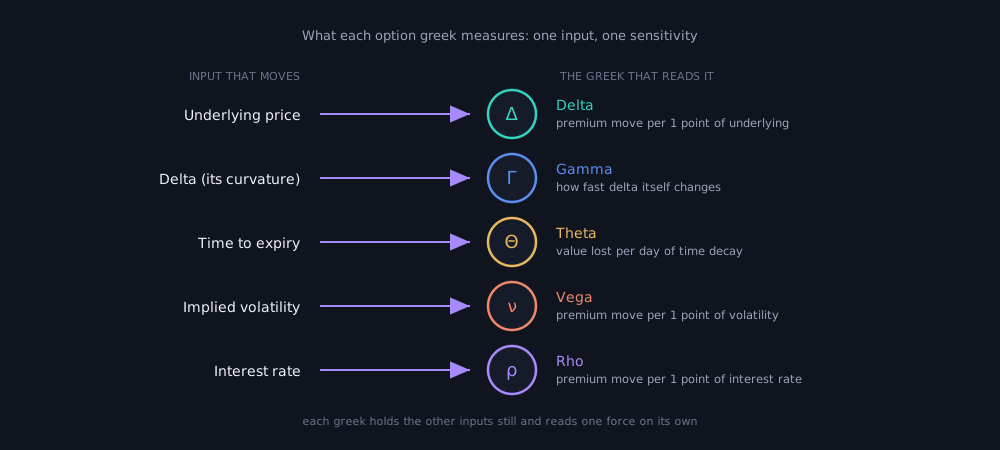
Figure 1: The five most-watched greeks, each mapped to the one input it measures. Illustrative schematic.
The Options Industry Council frames the same idea plainly: the greeks describe the expected change in an option's value as the underlying moves, as time passes, as implied volatility shifts, and as the risk-free rate changes. They are, in its words, a theoretical guidepost that gives an estimate of an option's value, not a guarantee of exact premium changes.
How the greeks are calculated
Every greek is the slope of the pricing model along one axis. Take the option's theoretical value, hold every input fixed except one, change that one input by a tiny amount, and measure how much the value moved. That ratio is the greek. Four of the five are first-order slopes, the immediate response to a single input. Gamma is the odd one out: it is a second-order slope, the rate at which delta itself changes.
Delta (Δ) = ∂V/∂S     change in option value per unit change in the underlying
Gamma (Γ) = ∂²V/∂S²   change in delta per unit change in the underlying
Theta (Θ)             change in option value as one day passes, with other inputs held fixed
Vega  (ν)             change in option value per one percentage-point change in implied volatility
Rho   (ρ)             change in option value per one percentage-point change in the interest rate

where
V = option value
S = underlying price
∂ = a small change in one input, holding all the others fixed
Vega and rho are written here per one percentage-point move, the usual trading convention; expressed as a raw partial derivative they would be quoted per whole unit of volatility or rate. Under the Black-Scholes model these slopes have closed forms. A call's delta, for instance, works out to N(d1), the cumulative normal of the model's first intermediate term, which is why a deep in-the-money call has a delta close to 1 and a far out-of-the-money call a delta close to 0. Two of the greeks, gamma and vega, come out identical for a call and a put on the same strike and expiry, while the others differ in sign or size between the two, a standard result of the derivation set out in Hull's textbook treatment. The exact algebra matters less for a trader than the intuition it encodes: each greek is just how hard the price leans when you push one lever.
Each greek isolates one of those forces and answers a single question: if this one thing moves, how much does the option move?How to read each greek
The five greeks divide cleanly by the question each answers. The table below is the reference; the behaviour underneath it is the point.
| Greek | Symbol | Measures sensitivity to | Order | Sign for a long option |
|---|---|---|---|---|
| Delta | Δ | the underlying price | first | call 0 to +1, put −1 to 0 |
| Gamma | Γ | delta (the curvature) | second | positive |
| Theta | Θ | the passage of time | first | usually negative |
| Vega | ν | implied volatility | first | positive |
| Rho | ρ | the interest rate | first | call positive, put negative |
Reference values per CBOE and The Options Industry Council; see Sources.
| A greek tells you | It does not tell you |
|---|---|
| Sensitivity right now | What will happen next |
| The impact of one input changing | Full P&L if all inputs move |
| Model-based exposure | A guaranteed premium change |
| Local risk | Risk after a large move |
| One individual force | Net portfolio risk across all legs |
Delta is the most-used of the five. It estimates the rupee change in the premium for a one-rupee move in the underlying, so a delta of 0.55 means a long call should gain about ₹0.55 of premium for every ₹1 the index rises. A call's delta runs from 0 to 1, a put's from −1 to 0, and an at-the-money option sits near 0.5 in magnitude. Traders also read delta loosely as a rough proxy for the chance the option finishes in the money, though strictly that probability is a related but separate quantity in the model.
Gamma measures how fast delta moves. If delta is the speed of the option relative to the underlying, gamma is the acceleration. Gamma is positive for a long option and is largest when the option is near the money and close to expiry, which is exactly when delta swings most violently. Figure 2 shows the pair: delta as a smooth S-curve climbing from 0 to 1 across the strike, and gamma as a bell that peaks right at the money.
If delta is the speed of the option relative to the underlying, gamma is the acceleration.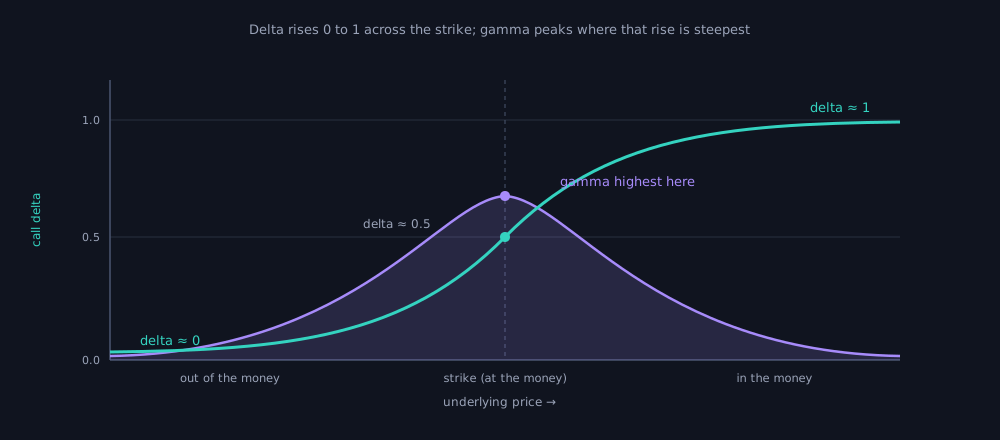
Figure 2: Delta climbs from 0 to 1 across the strike, and gamma peaks where that climb is steepest, at the money. Illustrative schematic.
Theta is the toll time charges. It is usually negative for a long option, because an option is a wasting asset: with every day that passes and nothing else changing, there is less time for the option to move into profit, so the premium decays. The CBOE describes theta as the change in the option's price as the expiration of the option approaches, and that decay is not even, it accelerates as expiry nears. This is the force that quietly emptied the Nifty call in the opening example.
Vega measures sensitivity to implied volatility, the market's expectation of how much the underlying will move. A vega of 8 means the premium should rise by about ₹8 for each one-point rise in implied volatility, and fall by the same for a drop. Long options have positive vega, so a buyer benefits when the market grows more fearful or uncertain and the implied volatility priced into the option rises.
Rho measures sensitivity to the risk-free interest rate. For the short-dated contracts that make up most F&O volume, rho is small and often ignored; it earns attention mainly on long-dated options, where a one percentage-point move in rates can shift the premium meaningfully.
A worked example in rupees
Numbers make the greeks concrete. Suppose a Nifty 50 call is trading at a premium of ₹120, with the greeks shown below, and then three things happen in a single session: the index rises 50 points, one full day passes, and implied volatility climbs two points.
| Input that moves | Greek | Move | Effect on premium |
|---|---|---|---|
| Underlying up 50 points | delta 0.55 | +50 | +₹27.5 |
| One day of time decay | theta −6 | −1 day | −₹6.0 |
| Implied volatility up 2 points | vega 8 | +2 | +₹16.0 |
| Net change | +₹37.5 |
Illustrative figures, not a real strategy or a recommendation.
Each greek contributes a piece, and the premium ends near ₹157.5, a touch above ₹120 plus the net ₹37.5, before second-order effects like gamma adjust delta along the way. Figure 3 draws the same arithmetic as a bridge, so it is clear which force lifted the premium and which one dragged at it. The point of the picture is that no single greek explains the day; the move is the sum of several.
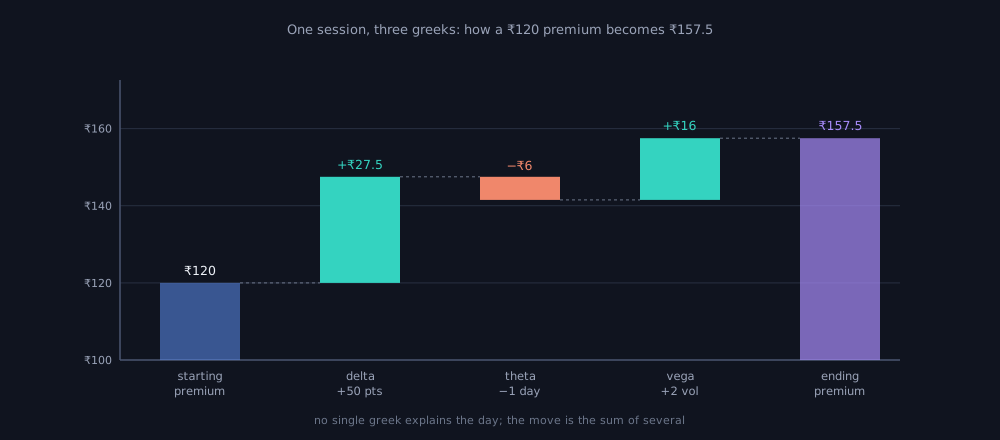
Figure 3: The same premium rebuilt as a bridge, delta and vega lifting it, theta dragging at it. Illustrative figures.
Limits and pitfalls
The greeks are powerful precisely because they simplify, and that simplification is also where they mislead.
First, they are local. A greek describes the response to a small move, measured right now. Delta of 0.55 is accurate for the next point or two, but as the underlying travels, gamma changes delta, vega and theta shift, and yesterday's numbers no longer hold. The greeks are a snapshot, not a forecast, and the snapshot ages quickly in a fast market.
Second, they assume everything else stays still. Each greek isolates one input by holding the rest constant, but real sessions move several inputs at once. A vega gain can be swamped by a theta loss; a delta gain can be undone by a volatility crush after a result or an event. Read one greek alone and you are reading one line of a five-line story.
The greeks are a snapshot, not a forecast, and the snapshot ages quickly in a fast market.Third, they inherit the model's assumptions. The Black-Scholes greeks assume a particular, well-behaved picture of how prices move and how volatility behaves. Real markets gap, jump, and show a volatility "smile" the basic model does not. The greeks are still the right language for risk, but a number derived from a model is only as honest as the model underneath it.
A checklist before you trust the option greeks
Before leaning on a greek, ask:
- Which input does this greek measure, and is that the input actually moving today?
- How old is the number, and how far has the underlying travelled since it was computed?
- Am I reading the greeks together, or fixating on one while another quietly works against me?
- For a long option, does the sign make sense: negative theta, positive vega, positive gamma?
- Is this a short-dated contract where rho barely matters, or a long-dated one where it does?
- Does the pricing model behind these greeks fit the way this underlying actually moves?
The greeks turn a vague worry, "this option could lose value", into a measured one, "theta is costing about ₹6 a day and vega will hurt if volatility falls". That measurement is most useful before capital is committed, while a strategy is still being tested against history. A position that holds many option legs has greeks that net against each other, and seeing that net exposure across a full backtest, rather than guessing at it leg by leg, is part of putting a real validation layer between an idea and live money. That is the layer daZh by Zudora is built to be: a place to configure options strategies, test them over historical data, and read the risk they carry before any of it is real. A greek cannot promise the next move. Reading it well means knowing which force it measures, and remembering the other four are moving too.
Frequently asked questions
What are the option greeks?
The option greeks are sensitivities that measure how much an option's theoretical value changes when one pricing input moves: delta and gamma track the underlying price, theta tracks time, vega tracks volatility, and rho tracks the interest rate.
What do delta, gamma, theta, vega, and rho measure?
Delta measures sensitivity to the underlying price, gamma the rate at which delta itself changes, theta the effect of time passing, vega sensitivity to implied volatility, and rho sensitivity to the risk-free interest rate.
Which option greek matters most?
It depends on what is moving: delta and gamma dominate when the underlying moves, theta weighs more as expiry nears, and vega matters when volatility shifts. The greeks are read together rather than ranked, because several inputs usually move in the same session.
Do the option greeks change?
Yes. Each greek is a local measure computed for a small move right now, so as the underlying travels, time passes, and volatility shifts, the numbers change and quickly stop holding in a fast market.
Is delta the same as the probability an option expires in the money?
No. Delta estimates the rupee change in the premium for a one-rupee move in the underlying. Traders read it loosely as a rough proxy for that probability, but strictly the two are related yet separate quantities in the model.
Why is theta usually negative for a long option?
Because an option is a wasting asset: with each day that passes and nothing else changing, there is less time for it to move into profit, so the premium decays, and that decay accelerates as expiry approaches.
Related concepts
- Implied volatility, the input vega measures and the one that often dominates an option's price.
- Position sizing, where greek exposure feeds the decision of how much to hold.
- Strategy validation, the process where an option strategy's risk is tested before deployment.
- How to Backtest an Options Strategy.
Disclaimer: daZh is a software platform for building, testing, and managing user-defined trading strategies. It does not provide investment advice, stock recommendations, guaranteed returns, or profit assurance. Backtests are based on historical data and assumptions; actual trading results may differ.
Sources
- Fischer Black and Myron Scholes, "The Pricing of Options and Corporate Liabilities", Journal of Political Economy, 1973, 81(3): 637 to 654 (the originating option pricing model from which the greeks are derived). https://www.sfu.ca/~kkasa/BlackScholes_73.pdf
- CBOE, "Learning the Greeks: An Expert's Perspective", CBOE Insights. https://www.cboe.com/insights/posts/learning-the-greeks-an-experts-perspective/
- The Options Industry Council, "Understanding Options Greeks", OptionsEducation.org. https://www.optionseducation.org/advancedconcepts/understanding-options-greeks
- John C. Hull, "Options, Futures, and Other Derivatives", chapter "The Greeks" (the canonical textbook treatment of option sensitivities and hedging). Pearson.