Backtesting an options strategy means running a fully specified set of rules against historical data to see how it would have behaved, the question the CFA Institute frames as "how would this strategy have performed if it were implemented in the past". For a stock strategy, that is mostly a matter of logic. For an options strategy, it is mostly a matter of honesty.
The rules are the easy part. An options backtest succeeds or fails on the realism beneath them: whether the historical option prices were real and tradable, whether the costs and the slippage were modelled, and whether the fills could actually have happened. Get those wrong and a strategy can look excellent on screen while being impossible to run with real money.
This matters more in options than almost anywhere else, because options are now where most of the activity sits. Of every ₹100 individual traders put into equity derivatives, the share going into index options rose from about ₹5 in FY20 to ₹41 in FY25, according to a SEBI study. Index options alone made up roughly 86% of equity-options premium turnover in April 2025, per National Stock Exchange data. A method for testing these strategies honestly is worth getting right.
Why options are harder to test than stocks
A stock has one price at any moment. An option has hundreds. Every underlying carries a chain of contracts across many strike prices and several expiries, each with its own price, its own liquidity, and its own behaviour. The strike is the price at which the option can be exercised; the expiry is the date it settles. A backtest has to pick the right contract at every step, and the contract it picks may have barely traded.
A stock has one price at any moment. An option has hundreds.Liquidity is the first trap. Near the money, the most active strikes are deep and tight. Away from the money, or in a far expiry, an option can go long stretches with almost no trades, so any historical price you find there may be stale or unreachable. As one options-data provider puts it, contracts "trade infrequently, especially those with far out-of-the-money strike prices or distant expiration dates". A backtest that trades those strikes is trading prices that were never really available.
The second difference is cost. Trading costs in options are charged on the premium, not on the notional value, and the premium is a small fraction of the notional. The premium is the price paid for the option; the notional is the value of the underlying it controls. On the National Stock Exchange, the notional-to-premium ratio for index options ran between roughly 410 and 712 times through late 2024 and early 2025. So a cost that looks negligible against the position size is large against the premium that actually changes hands, and it lands on every trade. This is the same discipline of signal plus microstructure plus cost control that separates a real edge from a paper one.
How to backtest an options strategy
Done properly, an options backtest moves through a fixed sequence. Figure 1 lays it out. Each step is a place where realism can quietly leak away.

Figure 1: The options-backtest sequence. Each step is a place realism can leak away.
Start by defining the strategy completely. Not just the view, but the exact contract rules: which strike, chosen how (at-the-money, a fixed distance out, or a delta target); which expiry; the entry and exit conditions; the position size; and what happens on an adjustment or a roll. The same precision a no-code strategy builder forces on equity rules is what an options strategy needs here.
An options strategy that is vague about strike selection is not yet testable.An options strategy that is vague about strike selection is not yet testable. Then source realistic historical data, the step most retail backtests skip. You need the option's own traded prices across the chain, with the bid and the ask, not the underlying's price alone. An option's value is driven by its implied volatility and its time decay, not just where the stock went, where implied volatility is the market's estimate of future movement priced into the option. A backtest run on spot prices alone is testing a different instrument. Many historical datasets, the same provider notes, "lack information about bid-ask spreads, implied volatility values, or intraday price movements". If your data is missing those, your result is missing them too.
Model the costs honestly, because in options they are not a rounding error. On a sold option, the securities transaction tax, or STT, is now 0.15% of the premium, raised from 0.10% with effect from April 1, 2026. On top of that sit exchange transaction charges of about 0.035% of premium, the SEBI turnover fee, stamp duty of 0.003% on the buy side, 18% GST on the charges, and brokerage. Every one of these is computed on the premium. A backtest that fills at the mid-price and ignores them is reporting an edge it could never have kept.
Model the fills, not just the costs. Between the bid and the ask sits a spread you pay every time you cross it, and on a thin option that spread can be a real share of the premium. Assume you buy at the ask and sell at the bid, not at a friendly mid-point, and on illiquid strikes assume worse. Slippage, the gap between the price you expected and the price you got, is larger in options than in liquid stocks, and it compounds on every leg of a multi-leg trade.
Handle expiry and settlement the way the exchange does. Index options are cash-settled and European-style, exercisable only at expiry, where they settle automatically. Single-stock options are physically settled, so an in-the-money position at expiry becomes delivery of the actual shares, a SEBI rule in force since the October 2019 expiry. A backtest that quietly closes everything at a convenient price on expiry day is not modelling what would really have happened. Weekly expiries changed too: since November 20, 2024, each exchange offers weekly contracts on only one index.
Finally, respect margin. Writing options ties up capital: a SPAN margin sized to a one-day worst-case loss, plus an exposure margin on top, both collected upfront under a SEBI framework that has applied since December 2020. A backtest that books a short straddle without charging that margin can show a position the trader could never have funded.
To make this concrete, picture a Nifty short straddle, a sold call and put at the same strike. Tested with entry and exit at the mid-price and no costs, it may look steadily profitable. Run the same test entering at the bid and the ask, with STT, brokerage, exchange charges, GST, slippage, and margin all charged, and the curve may flatten or even turn negative. The strategy did not change; the realism did.
Where options backtests mislead, and how to check them
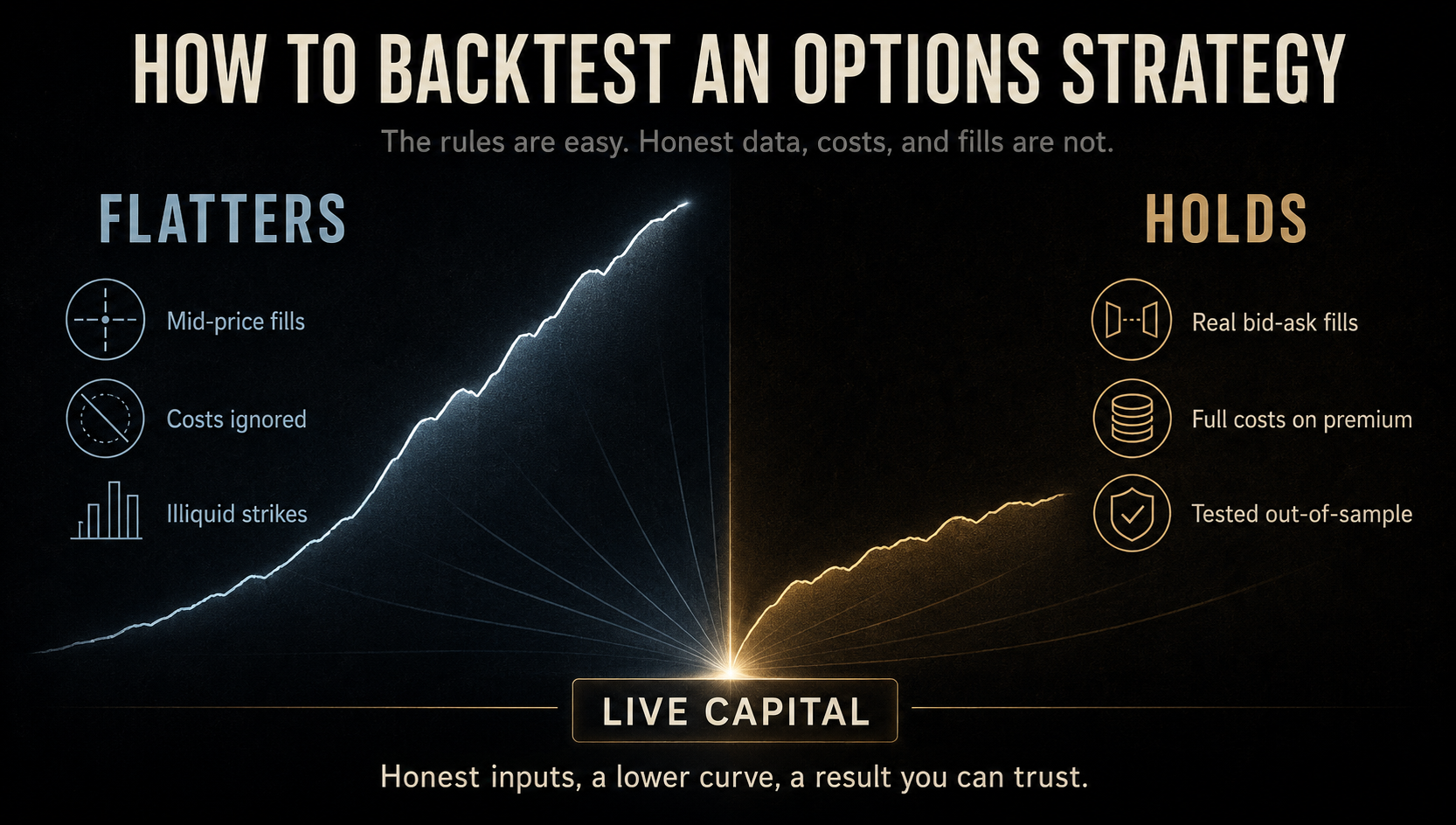
Even with clean data and honest costs, a backtest can still mislead, and the failure is usually the same: a result tuned to the past that does not survive the future. Figure 2 shows the gap between a backtest that flatters and one that holds.

Figure 2: The same strategy, tested naively and tested honestly. Realistic inputs lower the curve and raise its meaning.
The most common trap is overfitting: tuning the strikes, the exits, and the filters until the strategy fits the noise of one history rather than any real signal. The danger is mathematical, not just cautionary. The researchers Bailey, Borwein, Lopez de Prado and Zhu showed that after only about twenty variations tried on the same data, a researcher is expected to find one that looks good purely by chance. Campbell Harvey and Yan Liu go further, arguing that a backtested Sharpe ratio, a measure of return per unit of risk, should often be discounted by half or more, because "the discount is a result of data mining".
Two quieter biases distort options backtests in particular. Look-ahead bias, in the words of a CFA Institute monograph, "arises when information that would not have been available during the time period being studied is used". Using an option's end-of-day settlement price as if you could have traded it intraday is exactly this. Survivorship bias creeps in when expired or delisted contracts drop out of the dataset, so the test only sees the instruments that lasted. Honest options data has to keep the contracts that died.
The check for all of it is the same, and it is the discipline that separates a backtest from a paper trade. Hold out data the strategy never saw while it was being built, and judge it there, out-of-sample, before any capital is involved. A strategy that only looks good on the history it was tuned to has told you nothing yet. A backtest, as Bailey and his co-authors put it, is "a historical simulation", not a forecast.
A strategy that only looks good on the history it was tuned to has told you nothing yet.Data needed for an honest options backtest
Most of the difficulty above comes down to one thing: having the right data, at the right resolution, before you start. The checklist below is the minimum an honest options backtest needs.
- The underlying price, aligned to the option's own timeline.
- The option's symbol, strike, expiry, and type, whether it is a call or a put.
- The bid, the ask, and the last traded price, not just one of the three.
- Volume and open interest, to judge whether a strike was actually tradable. Open interest is the number of contracts still outstanding.
- Implied volatility, which drives the option's price as much as the underlying does.
- Timestamped intraday data, so a fill is checked against the price at that moment, not the day's close.
- The expiry and settlement rules for the contract, cash-settled or physical.
- Transaction costs, brokerage, taxes, and margin, charged on every trade.
From a clean curve to a trustworthy one
The instinct with an options backtest is to admire the equity curve. The more useful instinct is to interrogate everything beneath it: where the prices came from, whether they were tradable, what the costs really were, and whether the result holds on data it has never seen. Honest inputs usually produce a less impressive curve, and a far more trustworthy one.
Honest inputs usually produce a less impressive curve, and a far more trustworthy one.That distance, between a backtest that looks good and one you can actually rely on, is where daZh by Zudora works. It is built as the validation layer between a trading idea and live capital: a place to define an options strategy precisely, test it against realistic costs and fills, and examine how it behaves before any money is at stake.
Disclaimer: daZh is a software platform for building, testing, and managing user-defined trading strategies. It does not provide investment advice, stock recommendations, guaranteed returns, or profit assurance. Backtests are based on historical data and assumptions; actual trading results may differ.
Sources
- CFA Institute, "Backtesting and Simulation", curriculum refresher reading. https://www.cfainstitute.org/insights/professional-learning/refresher-readings/2026/backtesting-and-simulation
- SEBI, "Comparative study of growth in Equity Derivatives Segment vis-a-vis Cash Market after recent measures", research study, July 7, 2025 (individuals' index-options share of equity-derivatives spend, FY20 to FY25). https://www.sebi.gov.in/reports-and-statistics/research/jul-2025/comparative-study-of-growth-in-equity-derivatives-segment-vis-vis-cash-market-after-recent-measures_95105.html
- National Stock Exchange, "Market Pulse", Volume 7, Issue 5, May 2025 (index-options share of equity-options premium turnover; notional-to-premium ratio). https://nsearchives.nseindia.com/web/sites/default/files/inline-files/Market%20Pulse_May%202025.pdf
- Intrinio, "Using Historical Options Data to Backtest Strategies", March 18, 2026 (historical options data gaps; illiquid strikes). https://intrinio.com/blog/using-historical-options-data-to-backtest-strategies
- National Stock Exchange, "Changes in relation to rates of Securities Transaction Tax", circular NSE/FATAX/73524, March 31, 2026 (STT on option sale raised to 0.15% of premium, effective April 1, 2026, per the Finance Act, 2026). https://nsearchives.nseindia.com/content/circulars/FATAX73524.pdf
- National Stock Exchange, "Stamp Duty" (investor levies; equity options stamp duty 0.003%, buy side). https://www.nseindia.com/static/invest/first-time-investor-stamp-duty-charges-taxes
- NSE Clearing, "Settlement Mechanism, Equity Derivatives" (index options: cash-settled, European-style, automatic exercise). https://www.nseclearing.in/clearing-settlement/equity-derivatives/settlement-mechanism
- SEBI, "Physical settlement of stock derivatives", circular SEBI/HO/MRD/DOPI/CIR/P/2018/161, December 31, 2018 (all stock derivatives physically settled from the October 2019 expiry). https://www.sebi.gov.in/legal/circulars/dec-2018/physical-settlement-of-stock-derivatives_41482.html
- SEBI, "Measures to Strengthen Equity Index Derivatives Framework for Increased Investor Protection and Market Stability", circular SEBI/HO/MRD/TPD-1/P/CIR/2024/132, October 1, 2024 (weekly expiry limited to one benchmark index per exchange, from November 20, 2024). https://www.sebi.gov.in/legal/circulars/oct-2024/measures-to-strengthen-equity-index-derivatives-framework-for-increased-investor-protection-and-market-stability_87208.html
- SEBI, "Framework to Enable Verification of Upfront Collection of Margins from Clients in Cash and Derivatives segments", circular SEBI/HO/MRD2/DCAP/CIR/P/2020/127, July 20, 2020 (upfront margin collection, effective December 1, 2020). https://www.sebi.gov.in/legal/circulars/jul-2020/framework-to-enable-verification-of-upfront-collection-of-margins-from-clients-in-cash-and-derivatives-segments_47101.html
- David H. Bailey, Jonathan Borwein, Marcos Lopez de Prado, Qiji Jim Zhu, "Pseudo-Mathematics and Financial Charlatanism: The Effects of Backtest Overfitting on Out-of-Sample Performance", Notices of the American Mathematical Society, Vol. 61, No. 5, May 2014. https://www.ams.org/notices/201405/rnoti-p458.pdf
- Campbell R. Harvey and Yan Liu, "Backtesting", The Journal of Portfolio Management, Vol. 42, No. 1, Fall 2015. https://people.duke.edu/~charvey/Research/Published_Papers/P120_Backtesting.PDF
- Joseph Simonian, "Investment Model Validation: A Guide for Practitioners", CFA Institute Research Foundation, 2024 (definitions of look-ahead and survivorship bias). https://rpc.cfainstitute.org/sites/default/files/-/media/documents/article/rf-brief/investment-model-validation.pdf
- National Stock Exchange, "Revision in Transaction Charges", circular NSE/FA/64232, September 27, 2024 (exchange transaction charges on options, about 0.035% of premium). https://nsearchives.nseindia.com/content/circulars/FA64232.pdf
- National Stock Exchange, "SEBI Turnover Fees, STT and Other Levies" (SEBI turnover fee, ₹10 per crore). https://www.nseindia.com/static/invest/first-time-investor-sebi-turnover-fees-stt-other-levies