A trading idea usually arrives with a chart attached. The rule looks obvious in hindsight, the entries line up with the rallies, and the temptation is to fund it that afternoon. Strategy validation is the discipline that sits between that moment and the first live order. It is the process of confirming, through a sequence of deliberate tests, that an idea has a real and durable edge rather than a flattering coincidence, before any capital is committed to finding out.
Definition
"Strategy validation is the disciplined sequence of tests, a realistic backtest, then out-of-sample and walk-forward testing, Monte Carlo, and paper trading, that checks whether a trading edge holds up before any capital is committed."
The word "validation" carries more weight than "backtest" because it is plural. A single backtest answers one question well and several others not at all. Strategy validation is the full chain: a realistic backtest, then out-of-sample and walk-forward testing, then Monte Carlo robustness checks, then paper trading. Monte Carlo simulation, a method that re-runs the same history in many randomised orderings, sits near the end of that chain. Each link exists to remove a specific way of being wrong, and the order matters, because each step assumes the one before it has already been passed.
The cost of skipping the chain is not theoretical. SEBI found that 93% of individual traders in the equity futures and options segment lost money between FY22 and FY24, with aggregate losses above ₹1.8 lakh crore. Validation promises nothing about that ratio. What it does is move the moment of discovery, when a strategy turns out to be weaker than it looked, off live capital and onto a test.
Each link in that chain exists to remove a specific way of being wrong.The sequence at a glance
Each step answers a different question and catches a different failure. Read together, they are a map of what a strategy report is actually telling you.
| Validation step | Question it answers | What it catches |
|---|---|---|
| Realistic backtest | Did the idea ever have an edge under realistic assumptions? | Bad rules, unrealistic fills, missing costs |
| Out-of-sample test | Did the edge survive data it was not fitted on? | Overfitting |
| Walk-forward test | Did the edge survive repeated unseen windows? | One lucky holdout period |
| Monte Carlo simulation | Did the result depend on a lucky order of trades? | Path luck, hidden drawdown risk |
| Paper trading | Can the strategy run in real time? | Execution gaps, missed signals, trader behaviour |
It starts with a backtest that tells the truth
Strategy validation begins with a backtest, but an honest one. A backtest runs a fully specified rule set, its entries, exits, position sizing, and cost assumptions, across historical data and reports how that exact strategy would have behaved had it been run unchanged.
The reach is the appeal. Years of conditions resolve in seconds. The danger is that the past is fixed and known, and a known past is easy to flatter. The CFA Institute, in its refresher reading on backtesting and simulation, singles out two behavioural traps. The first is survivorship bias, where instruments that failed have quietly dropped out of the data. The second is look-ahead bias, where information that was not available at the time leaks into the test. A backtest that fills orders at prices a live trader could never have reached, or that ignores real trading costs, is measuring an edge that never existed to be captured.
So the first job is not to produce a good backtest. It is to produce a true one. A backtest is only as honest as its assumptions, and a strategy that cannot survive realistic assumptions has already failed before any of the later tests are run.
A realistic backtest is also more than entries and exits. It has to charge what trading actually costs, transaction costs, slippage, and honest execution assumptions, and it has to report more than a single return: the maximum drawdown a trader would have had to sit through, the Sharpe ratio that weighs return against risk, the number of trades behind the result, the time spent in the market, and the range of market regimes the test actually covered. A return stripped of that context is the easiest number in trading to flatter.
A return stripped of that context is the easiest number in trading to flatter.Out-of-sample and walk-forward testing catch the fit
A truthful backtest still leaves the largest danger in algorithmic trading untouched: overfitting, where a strategy fits the quirks of one stretch of history rather than any signal that will persist. Tune enough parameters against the same data and a strategy starts to fit its noise. Bailey, Borwein, López de Prado, and Zhu showed the problem precisely. In "Pseudo-Mathematics and Financial Charlatanism", published in the Notices of the American Mathematical Society in 2014, they prove that high simulated performance is easily achievable after testing a relatively small number of strategy configurations, and that the more configurations are tried, the greater the probability the backtest is overfit.
Out-of-sample testing is the first defence. The data is split: the strategy is built and tuned on one part, then run once, untouched, on a part it has never seen. If the edge holds on data that played no role in shaping the rules, it is more likely to be real. If it collapses, the in-sample result was a fit to the past.
Walk-forward testing extends the same logic over time. Instead of one split, the test rolls forward in steps, calibrating on a window of history and then trading the period just after it, again and again across the data. The CFA Institute describes this rolling-window method as one where researchers fit signals on a window, rebalance, and track performance forward, a closer proxy for how a strategy would actually be run. It is a harder test to pass than a single backtest, and that is the point.
If the edge holds on data that played no role in shaping the rules, it is more likely to be real.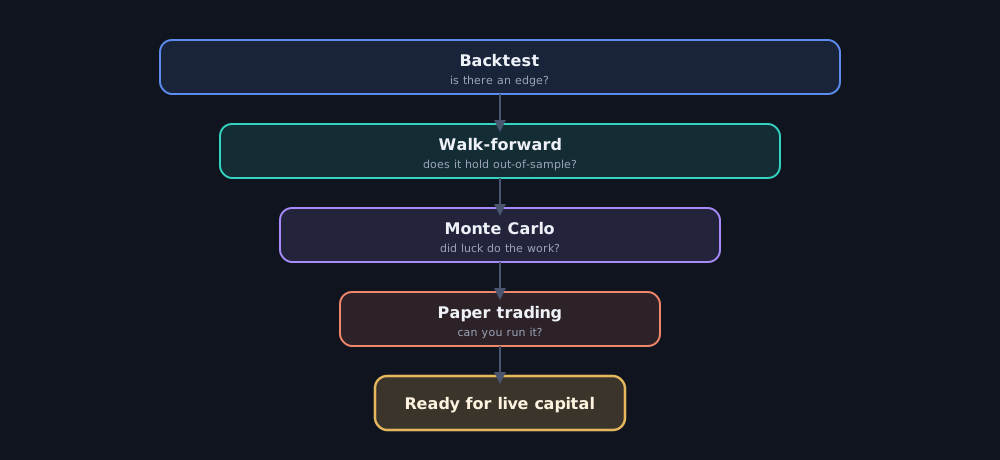
Figure 1: Validation as a narrowing funnel. Each stage admits fewer strategies than the one before it, and only what survives every stage reaches live capital.
Monte Carlo asks whether luck did the work
Figure 1 shows the sequence as a funnel, and Monte Carlo robustness checks are where it narrows hard. A strategy that survives walk-forward testing has cleared a real bar, but its result is still a single path: one ordering of trades, one sequence of wins and losses that happened to occur. Reorder those same trades and the equity curve, and the worst drawdown along it, can look very different.
Monte Carlo simulation probes that fragility by generating many alternative versions of the same history. The CFA Institute frames it as a way to see whether extreme outcomes could wreck performance that a single backtest made look smooth. Resampling the sequence of trades, or perturbing the inputs, produces a distribution of results instead of one number. A strategy whose edge holds across thousands of reorderings has stronger evidence of robustness, because its result depends less on one favourable sequence of trades. One whose attractive result depended on a lucky order of trades reveals itself here, before that luck is asked to repeat with real money.
This is also where the limits of any single historical test become clear. López de Prado, in Advances in Financial Machine Learning, argues that a single walk-forward path is easily overfit precisely because it rests on one historical sequence, and that testing across many combinations of train and test data gives a more honest read on whether an edge is real. Monte Carlo is one practical expression of that caution: it asks the trader to judge the strategy by a distribution of possible paths rather than by the one path history happened to deliver.
Judge the strategy by a distribution of possible paths rather than by the one path history happened to deliver.Paper trading tests the trader, not just the rules
Every step so far tests the strategy in the abstract. Paper trading, also called forward testing, tests something the data cannot reach: whether a person can actually run the strategy as the market moves. It runs the rules in real time on live prices, with imaginary money, at the speed of the present rather than the speed of a replayed past.
What it surfaces is execution and behaviour. Can the orders be placed on time, day after day? Does the trader follow the system when it is losing, or quietly widen a stop "just this time"? These are the failures a backtest can never show, because a backtest has no hesitation, no missed signal, and no human watching a falling position. The gap between a strategy on paper and a person operating it is exactly what forward testing measures, and it is treated at greater length in our explainer on paper trading versus backtesting.
Paper trading has its own blind spot, which is that nothing is at stake. A simulated fill can land at a price a live order would have missed, and a position that costs nothing to hold is easy to hold. That is why it sits last in the sequence rather than first. It is the rehearsal after the strategy has already earned the right to be rehearsed, the final check before live capital, which is no longer a test.
Why the order of strategy validation is the point
The four steps are not interchangeable, and running them out of order wastes the effort. A realistic backtest measures whether an edge ever existed. Out-of-sample and walk-forward testing then ask whether that edge was fitted to one stretch of noise or holds beyond it. Monte Carlo turns to luck, testing whether the result depended on a single fortunate ordering of trades. Last comes paper trading, where the question is no longer about the strategy but about the human running it. Skip the backtest's honesty and every later test inherits a flattering result. Skip the out-of-sample split and Monte Carlo is just resampling an overfit. Each step assumes the previous one passed.
At each stage, the difference between a healthy result and a warning sign is usually clear.
| Stage | Healthy sign | Warning sign |
|---|---|---|
| Backtest | Profitable after costs and slippage | Works only before costs |
| Out-of-sample | Lower but still positive performance | Performance collapses |
| Walk-forward | Several windows remain viable | One window carries the whole result |
| Monte Carlo | Tail drawdowns are survivable | 95th-percentile drawdown breaks the account |
| Paper trading | Signals execute close to assumptions | Fills, delay, or discipline break the strategy |
None of this produces a forecast, and treating it as one is its own kind of error. A backtest describes the past, out-of-sample testing describes a sample, Monte Carlo describes a distribution, and paper trading describes a rehearsal without stakes. Together they narrow uncertainty; none of them erases it. A strategy that has survived the full chain has stronger evidence of a real edge than one that survived only the convenient test. Choosing the platform that runs that chain well is part of the decision, which is why it features in our guide on what no-code algo trading actually involves.
A checklist before you trust a strategy
Before trusting a strategy, ask:
- Was the backtest built with realistic costs and slippage?
- Was the strategy tested on data it was not fitted on?
- Did it survive walk-forward testing across multiple windows?
- Did Monte Carlo show survivable tail drawdowns?
- Did the strategy remain viable after worse execution assumptions?
- Did paper trading reveal missed signals, delay, or discipline problems?
- Are the results supported by more than one metric, not just return?
- Is the strategy robust enough to deserve live capital, or only interesting enough for further testing?
This is the layer daZh by Zudora is built to occupy, the validation layer between a trading idea and live capital. It is designed to run the sequence in order, so the doubts about an idea are resolved on a test rather than on an account. A validated strategy is not a promised one. It is one that has been given every honest chance to fail somewhere other than the market.
Related concepts
- Overfitting, the failure the sequence exists to catch.
- Walk-forward analysis, the rolling out-of-sample step.
- Monte Carlo simulation, the robustness step.
- Out-of-sample testing, the held-out check.
- Drawdown, the risk a validated strategy must survive.
- Paper Trading vs Backtesting.
Disclaimer: daZh is a software platform for building, testing, and managing user-defined trading strategies. It does not provide investment advice, stock recommendations, guaranteed returns, or profit assurance. Backtests are based on historical data and assumptions; actual trading results may differ.
Sources
- SEBI, "Updated study reveals 93% of individual traders incurred losses in Equity F&O between FY22 and FY24; aggregate losses exceed ₹1.8 lakh crore over three years", press release, September 23, 2024. https://www.sebi.gov.in/media-and-notifications/press-releases/sep-2024/updated-sebi-study-reveals-93-of-individual-traders-incurred-losses-in-equity-fando-between-fy22-and-fy24-aggregate-losses-exceed-1-8-lakh-crores-over-three-years_86906.html
- CFA Institute, "Backtesting and Simulation", CFA Program refresher reading, 2026 curriculum. https://www.cfainstitute.org/insights/professional-learning/refresher-readings/2026/backtesting-and-simulation
- David H. Bailey, Jonathan M. Borwein, Marcos López de Prado, Qiji Jim Zhu, "Pseudo-Mathematics and Financial Charlatanism: The Effects of Backtest Overfitting on Out-of-Sample Performance", Notices of the American Mathematical Society, May 2014. https://papers.ssrn.com/sol3/papers.cfm?abstract_id=2308659
- Marcos López de Prado, "Advances in Financial Machine Learning", Wiley, 2018. https://www.wiley.com/en-us/Advances+in+Financial+Machine+Learning-p-9781119482086
- Investopedia, "Paper Trade", orientation reference, accessed June 2026. https://www.investopedia.com/terms/p/papertrade.asp