Hold a lot of a stock you already own, sell one call option against it, and pocket the premium. That is the whole of a covered call strategy, and it is the most popular options income idea for a reason: it pays you for the upside you were probably not going to capture anyway. A call option is the right to buy the underlying at a fixed strike price by a set expiry date; selling one means collecting a premium today in return for agreeing to hand over your holding at the strike if the buyer wants it. While you hold the underlying, the sold call sits on top of it as a small, recurring income.
The catch is what the premium does not buy. Selling the call caps your gain at the strike, so a sharp rally leaves money on the table. More importantly, the premium is a thin cushion, not a hedge. If the underlying falls, you still own it all the way down, and the premium offsets only the first slice of that loss. The covered call does not remove the risk of holding the underlying; it trades away the top for a little protection at the bottom.
This guide walks the full path in three steps, build, backtest, then validate, and treats every strike, expiry, and rule as a hypothesis to test rather than advice to follow. A covered call is gentler than most option-selling rules, because the call you sell is covered by the holding you already own. That makes the short-call risk covered rather than open-ended, but the downside risk of the underlying remains substantial. It does not make the result automatic, and the only honest way to find out whether the income survives real costs and real falls is to test it.
The covered call does not remove the risk of holding the underlying; it trades away the top for a little protection at the bottom.What a covered call is and how its legs are structured
A covered call has two legs working together. The Options Industry Council defines the strategy as one that "consists of writing a call that is covered by an equivalent long stock position". So the first leg is the long underlying, held in lot-size quantity, and the second is a short call sold against it, usually one call per lot. Selling the call while owning the underlying is also called a buy-write, the structure that the Cboe S&P 500 BuyWrite Index tracks by holding an S&P 500 index portfolio and writing a near-term, at-the-money call month after month.
The payoff is the part worth committing to memory, a shape laid out in standard derivatives texts, and Figure 1 draws it. Three numbers define the position. The maximum profit, in the Options Industry Council's terms, is the "strike price minus stock purchase price plus premium received", reached once the underlying sits at or above the strike at expiry. Above that strike the line goes flat: the gains plateau no matter how far the underlying runs. The breakeven is the "starting stock price minus premium received", which is simply your cost lowered by the income you collected. The maximum loss is "limited but substantial": the worst case is the underlying falling to zero, in which case you lose its full cost, reduced only by the premium.
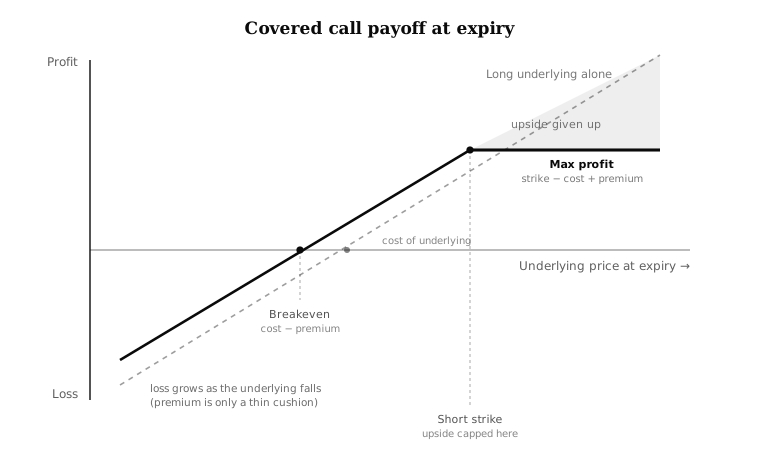
Figure 1: Below the strike the covered call behaves like the underlying with a premium head start; above the strike it goes flat. The dashed line is the underlying held alone, so the shaded wedge is the upside given up for the premium. Illustrative figures.
That shape makes the risk easy to name plainly. A covered call is a bounded-risk, capped-reward position: the short call is covered, but the underlying can still fall sharply. Both the most it can make and the most it can lose are known the moment it is opened, and the short call is covered by the underlying you already hold, so it carries none of the unlimited risk of a naked, uncovered call. This is the opposite end of the spectrum from a short straddle, whose losses can far exceed the premium. The honest caveat is that bounded does not mean small. The downside here is the underlying's own decline, which can be large, and the premium only thins it.
How to build it as a no-code rule set
A trading rule is a fully specified instruction with no room left for judgement, and a covered call converts into one cleanly. The structure is fixed: hold the underlying in lot-size quantity, sell one call per lot. Everything else is a choice you state in advance and then test. The first choice is strike selection. An at-the-money call, struck near the current price, collects the most premium but caps the upside almost immediately. An out-of-the-money call, struck above the current price, collects less but leaves room for the underlying to appreciate before the cap bites. A common systematic form is to pick the strike by delta, the option Greek that measures how much the option price moves for a one-rupee move in the underlying and doubles as a rough probability of finishing in the money.
The second choice is expiry. A weekly call decays faster and is rewritten often; a monthly call, the cadence the Cboe buy-write benchmark uses, trades less and collects a larger premium each time. The third is the entry and exit logic. The simplest rule sells a fresh call each cycle and holds it to expiry, then writes the next one. More active versions add a buy-back trigger, closing the short call early once most of its premium has decayed, or a roll, buying back a call that has gone deep in the money and selling a higher or later one to defer assignment. For single-stock options that are physically settled, an in-the-money short call held to expiry can require delivery of the underlying shares at the strike. A backtest must model that settlement rather than pretending the position simply continues with unlimited upside.
A trading rule is a fully specified instruction with no room left for judgement, and a covered call converts into one cleanly.Each of these is a distinct hypothesis with its own risk and reward, not a setting that is correct in the abstract. A nearer strike and a weekly expiry harvest more premium but cap the upside hard and trade often, paying costs each time. A further strike and a monthly expiry give the underlying room to run but collect thinner income. The roll defers a cap but can lock in a loss on the underlying. None of these is decided by argument. Each earns its place in a test, or it does not.
How to backtest it honestly
A backtest replays the rule against historical data and reports what it would have done. The CFA Institute frames the exercise as estimating "how would this strategy have performed if it were implemented in the past." For a covered call that means reconstructing both legs together, bar by bar: the value of the underlying you hold and the price of the call you sold, with the premium collected at entry and the position marked to the call's real historical prices, not the underlying's alone.
Costs come first, and a covered call is gentler here than a high-frequency option-selling rule because it trades infrequently, often once a cycle. Gentler is not free. Each call written and each call bought back pays brokerage, the securities transaction tax, exchange and regulatory charges, GST, and slippage, the gap between the price the rule assumed and the price it actually got. Those charges land on the premium, which is a small number, so they eat a meaningful share of the income on every cycle. The bid-ask spread, the gap between the best buy and sell quotes, is the quiet tax: a call sells at the bid and is bought back at the ask, and that round trip is paid in full each time the rule rolls. Liquidity by strike matters too. The most active calls sit near the money in near expiries; a far out-of-the-money or far-dated strike can have a stale or unreachable quote, so a backtest that writes those is collecting a premium that may not have been available.
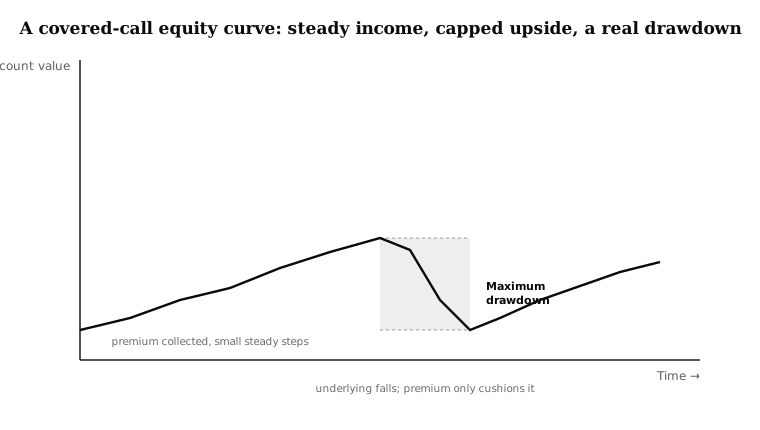
Figure 2: A covered-call curve climbs in small steady steps as premium accrues, then gives ground when the underlying falls, because the premium cushions a decline rather than stopping it. The shaded fall is the maximum drawdown. Illustrative figures.
Two more things keep the backtest honest. Assignment has to be modelled the way the exchange settles it: when the call finishes in the money, the underlying is called away at the strike, so the test must cap the gain there rather than quietly keeping the full rally. And every result is gross until costs are charged. A covered-call backtest that fills at the mid-price and skips fees will show income the rule could never have kept. Read the metrics in pairs. The return summary means little without the maximum drawdown, the largest peak-to-trough fall in the account, which on a covered call is driven by the underlying you hold, as Figure 2 shows. A flattering total can hide a sharp fall the premium never came close to covering.
A covered-call backtest that fills at the mid-price and skips fees will show income the rule could never have kept.How to validate it
Validation is the step that separates a rule that earns income from one that merely looked good on a calm stretch of history, and it is where a single backtest proves almost nothing. A covered call has only a handful of dials, the strike distance, the expiry length, the roll trigger, which makes it tempting to sweep dozens of combinations and keep the one with the best past curve. That is exactly how a rule gets fitted to the noise of one period, a trap called overfitting. Marcos López de Prado, in Advances in Financial Machine Learning, shows that the more configurations you test, the more likely the best one is luck rather than skill. The winner of a parameter sweep is usually the most overfit setting, not the most trustworthy.
The winner of a parameter sweep is usually the most overfit setting, not the most trustworthy.The defences are a sequence of tests, each harder than the last. Out-of-sample testing holds back a slice of history the tuning never touches, fits the strike and expiry choices on the rest, then tests once on the untouched slice. Walk-forward analysis is the stronger version: it rolls that split forward through time, retuning on each window and testing on the next unseen one, so the rule has to keep working as conditions change rather than having worked once. For a covered call this matters because the income depends on the regime. The strategy quietly assumes the underlying drifts sideways or up; a long, grinding decline turns a stream of small premiums into a slow bleed, and a violent rally turns the cap into a string of missed gains.
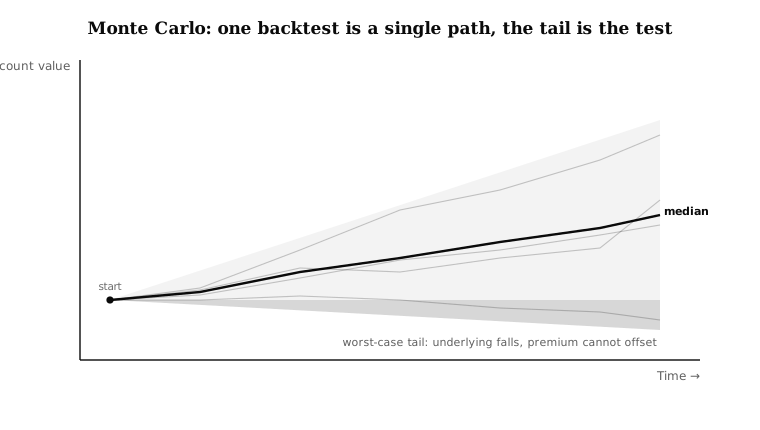
Figure 3: Monte Carlo resampling reorders the trade sequence thousands of times to show the spread of outcomes one backtest could have produced. For a covered call the lower tail, the run where the underlying keeps falling, is the number to watch. Illustrative figures.
The test that earns its keep is the Monte Carlo simulation, shown in Figure 3, which resamples or reorders the trades thousands of times to reveal the range of outcomes the rule could have produced rather than the single path a backtest happens to show. Two forces deserve special attention in that range. The first is implied volatility, the market's expectation of future movement priced into the call: richer when volatility is high, which makes the premium fatter but also signals a market that can move against the underlying. The second is the option Greeks, which describe how the position drifts as price, time, and volatility change; a covered call is net long the underlying and short the call, so it gains from time decay on the call leg but stays exposed to a fall in the underlying. Validation is what turns a backtest into strategy validation, and most configurations that look excellent on one window do not survive it.
Limits and pitfalls
The covered call has two failure modes, and they pull in opposite directions. The first is the cap. By selling the call you agree to give up everything above the strike, so a sharp rally is the strategy's bad day on the upside: you keep the premium and the gain to the strike, and watch the rest go to the buyer, as the shaded wedge in Figure 1 shows. That is opportunity cost, not a cash loss, but over a long bull run it can leave a covered call well behind simply holding the underlying. The second failure mode is the real one. The downside risk of owning the underlying is almost entirely intact. The Options Industry Council is explicit that the maximum loss is "limited but substantial", bounded only by the underlying falling to zero, and the premium offsets just the first part of that fall. A covered call is a mild, bounded-risk position, but mild is not safe, and selling calls on a holding that is quietly sinking is one of the more common ways the income gets overwhelmed by the loss underneath it. A reasonable hypothesis is not a verdict, and honest testing is what tells the two apart.
A checklist before you trust a covered call strategy
Before you treat a steady stream of premium as an edge, run the rule past a few honest questions.
| Checklist question | Why it matters |
|---|---|
| Did I define strike, expiry, entry, and exit before testing? | Prevents discretionary hindsight |
| Are brokerage, charges, and slippage included on every roll? | Prevents fantasy income |
| Do I know the maximum loss and find it acceptable? | The downside is the underlying's full fall, cushioned only by premium |
| Did the rule survive out-of-sample data? | Tests whether it generalises |
| Did walk-forward results stay stable across regimes? | Tests parameter robustness |
| Did Monte Carlo show a survivable lower tail? | Tests sequence and drawdown risk |
| Did I test a long decline and a sharp rally, not just sideways months? | A covered call assumes a flat-to-up underlying; a grinding fall bleeds it and a rally caps it |
Frequently asked questions
What is a covered call strategy?
It is an options income strategy that pairs a long position in the underlying, held in lot-size quantity, with a short call sold against it, usually one call per lot. The seller collects the premium and agrees to hand over the underlying at the strike if the call is exercised, so the upside is capped at the strike in exchange for the income.
What is the maximum profit and maximum loss on a covered call?
The maximum profit is the strike price minus the cost of the underlying plus the premium received, reached once the underlying sits at or above the strike at expiry. The maximum loss, per the Options Industry Council, is limited but substantial: the worst case is the underlying falling to zero, in which case you lose its full cost, reduced only by the premium collected.
Is a covered call a low-risk strategy?
It is lower risk than selling a naked call, because the short call is covered by the underlying you already own, so it has defined rather than unlimited risk. But it is not low risk in absolute terms. You still own the underlying all the way down, and the premium offsets only the first part of a fall, so a large decline still produces a large loss. This article is educational and not advice to trade it.
What is the breakeven on a covered call?
The breakeven at expiry is the cost of the underlying minus the premium received. Selling the call lowers your breakeven below your purchase price by the amount of premium, which is the small downside cushion the strategy provides.
How do you backtest and validate a covered call strategy?
Reconstruct both legs from real historical prices, charge brokerage, taxes, and slippage on every call written and bought back, and model assignment so the gain is capped at the strike. Then validate out-of-sample on data the rule was never tuned to, roll that split forward with walk-forward analysis, and use Monte Carlo resampling to see the worst-case tail when the underlying keeps falling.
Is a backtested covered-call result a prediction of future income?
No. A backtest describes how a rule behaved on historical data under stated assumptions. Past performance does not guarantee future results, and live conditions, option spreads, costs, and the path of the underlying can differ sharply from the test.
The covered call is the gentlest member of the options-selling family, which is exactly why its risks are easy to wave away: the cap feels free until a rally, and the cushion feels like a hedge until a fall. A steady run of premium on a finished chart is a hypothesis until it survives windows it has never seen, net of every cost, with its lower tail made visible. That survival is what daZh by Zudora is built to test: a no-code platform where an options rule like this can be specified with a visual leg configurator, backtested across history, then put through parameter optimisation, walk-forward analysis, overfitting detection, and Monte Carlo validation before any capital is committed.
Related guides
- Bull call spread strategy: build, backtest, and validate it
- Iron condor strategy: build, backtest, and validate it
- How to backtest an options strategy
- Implied volatility and the option Greeks
- Walk-forward analysis, out-of-sample testing, and Monte Carlo simulation
- Pillar: A framework for systematic trading
Disclaimer: daZh is a software platform for building, testing, and managing user-defined trading strategies. It does not provide investment advice, stock recommendations, guaranteed returns, or profit assurance. Backtests are based on historical data and assumptions; actual trading results may differ.
Sources
- The Options Industry Council (OCC), "Covered Call (Buy/Write)", options strategy reference (definition, maximum profit, maximum loss, breakeven, capped upside). https://www.optionseducation.org/strategies/all-strategies/covered-call-buy-write
- Cboe Global Markets, "Cboe S&P 500 BuyWrite Index (BXM) Methodology", index methodology document (buy-write structure: long index portfolio plus written near-term at-the-money call). https://cdn.cboe.com/api/global/us_indices/governance/BXM_Methodology.pdf
- John C. Hull, "Options, Futures, and Other Derivatives", Pearson (textbook treatment of writing a covered call and its payoff). https://www.pearson.com/en-us/subject-catalog/p/options-futures-and-other-derivatives/P200000005938
- CFA Institute, "Backtesting and Simulation", CFA Program refresher reading, 2026 curriculum. https://www.cfainstitute.org/insights/professional-learning/refresher-readings/2026/backtesting-and-simulation
- Marcos López de Prado, "Advances in Financial Machine Learning", Wiley, 2018 (backtest overfitting and validation). https://www.wiley.com/en-us/Advances+in+Financial+Machine+Learning-p-9781119482086