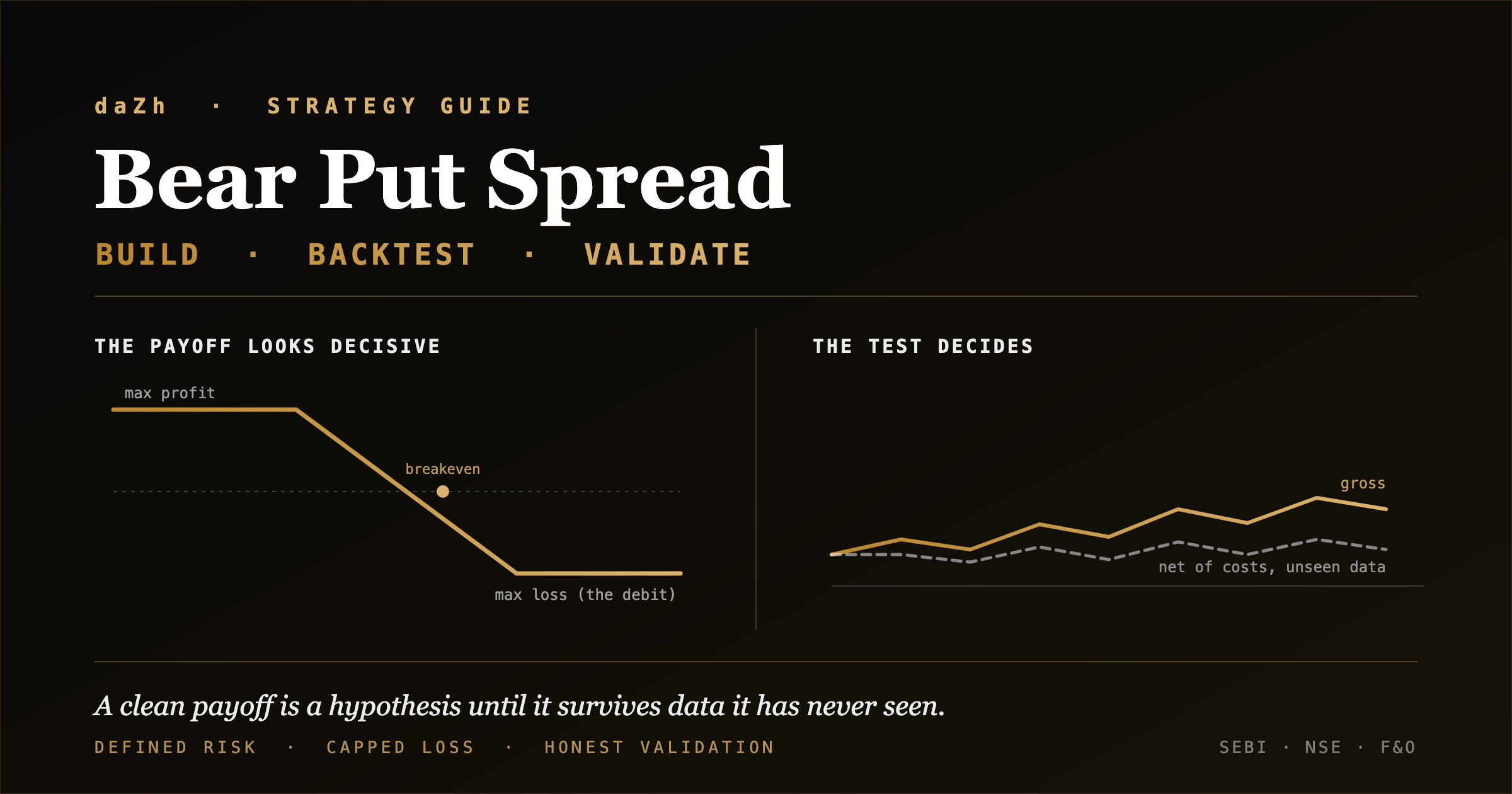
A bear put spread is the structured, budget-capped way to act on a falling view. Rather than buy a single put and pay full premium for it, a trader buys one put at a higher strike and sells another put at a lower strike on the same underlying and the same expiry, using the premium collected on the sold put to soften the cost of the bought one. What comes back is a position whose maximum gain, maximum loss, and single breakeven price are all fixed the moment it is opened.
That fixedness is the appeal, and it is also the easiest thing to overrate. A payoff that draws cleanly on a diagram looks like a plan, but a diagram is not a backtest, and a backtest is not yet an edge. The strikes you pick, the expiry you trade, and the signal that tells you to put the spread on are all assumptions, and assumptions have to be tested before they are trusted.
This guide walks the full path in three steps, build, backtest, then validate, and treats every strike, filter, and threshold as a hypothesis to test rather than advice to follow. The structure caps the downside, which changes what the testing is for. With an open-ended option-selling position the test exists to find the blow-up. With a bear put spread the loss is already bounded, so the test exists to find the quieter ways the rule disappoints.
What a bear put spread is and how its legs are structured
The strategy is a two-leg vertical spread built entirely from puts. A put is the right to sell the underlying at a fixed strike price by a fixed expiry. Following The Options Industry Council, a bear put spread "consists of buying one put and selling another put, at a lower strike, to offset part of the upfront cost". The bought put carries the higher strike, the sold put the lower strike, and both share the same expiry on the same underlying. John Hull's standard derivatives text describes the same structure, a bear spread "created by buying a put with a high strike price and selling a put with a low strike price". Because the higher-strike put costs more than the lower-strike put brings in, the position opens for a net debit, money paid out, which is what makes it a moderately bearish bet rather than a neutral one.
The numbers that matter are all fixed at entry, and Figure 1 shows them on the payoff. The maximum loss is the net debit paid, and nothing more: if the underlying finishes at or above the higher strike, both puts expire worthless and the debit is gone. The maximum profit is the distance between the two strikes minus that net debit, reached when the underlying finishes at or below the lower strike, where both puts are in the money and the spread is worth its full width. There is one breakeven, the higher (long put) strike minus the net debit. Above it the position loses, below it the position gains, up to the cap.
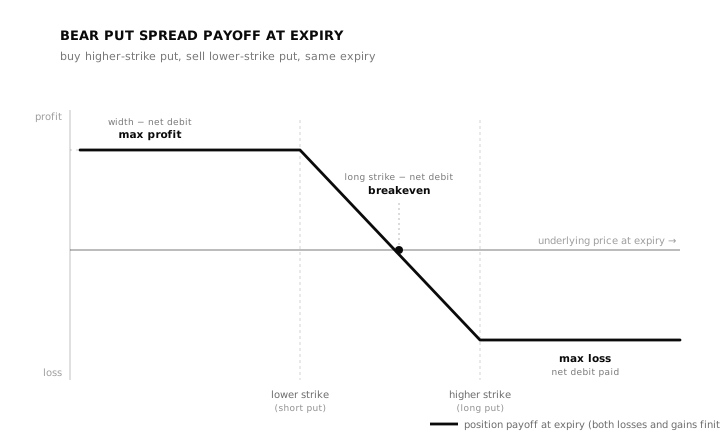
Figure 1: The bear put spread's payoff at expiry. Maximum profit is the spread width minus the net debit, maximum loss is the net debit, and the single breakeven is the long put strike minus the net debit. Illustrative figures.
The defining feature is that the risk is defined. Both the most the position can make and the most it can lose are known and finite before a single rupee moves, which is the deliberate contrast with selling a naked put or a straddle, where the downside is open-ended. A bear put spread cannot lose more than the debit you paid for it. That single property shapes everything that follows, because it means the danger is not a catastrophic tail but a steady erosion that a flattering backtest can hide.
A bear put spread cannot lose more than the debit you paid for it.Building the bear put spread as a no-code rule set
A trading rule is a fully specified instruction with no room left for judgement, and a bear put spread converts into one cleanly. The legs are fixed by definition: buy one put at the higher strike, sell one put at the lower strike, same expiry, same underlying, sized in lots, the exchange-defined bundle of units that an F&O contract trades in. What remains to specify is the four decisions that turn a structure into a strategy: which strikes, which expiry, what triggers the entry, and what closes the position.
Strike selection is the first lever and the most consequential. The long put is often placed at or just below the money, with the short put a chosen distance lower, and the gap between them, the spread width, sets both the cost and the ceiling. A wider gap pays out more at the maximum but costs a larger debit and so risks more; a narrower gap is cheaper and safer but caps the gain sooner. Expiry is the second lever: a weekly contract decays faster and is cheaper, a monthly contract gives the view more time to play out. Neither choice is correct in the abstract. They are knobs to search honestly and then validate.
They are knobs to search honestly and then validate.The entry is where the bearish hypothesis lives. The spread expresses a view that the underlying will fall, so the trigger is whatever rule encodes that view, and it must be written down before any test, not chosen after seeing the chart. It might be a trend filter such as price closing below a moving average, a momentum reading, a break of a support level, or a volatility condition. Each of these is a separate hypothesis with its own evidence to gather. The exit needs the same precision: a profit target stated as a share of the maximum profit, a stop stated as a fraction of the debit, a time-based exit some days before expiry to sidestep the sharpest decay, or holding to expiry and letting the contracts settle. A rule that is vague about its exit is not yet testable.
How to backtest it honestly
A backtest replays the rule against historical data and reports what it would have done, the exercise the CFA Institute frames as estimating "how would this strategy have performed if it were implemented in the past". For a bear put spread that means reconstructing both option legs bar by bar from historical prices, opening the spread when the entry rule fires, closing it on the exit rule, and recording every fill and the running account balance.
Costs come first, because a spread pays them twice over. Every entry is two option legs and every exit is two more, so a single round trip crosses four option transactions, each carrying brokerage, the securities transaction tax, exchange and regulatory charges, GST, and slippage, the gap between the price the rule wanted and the price it actually got. The debit on a bear put spread is small by design, and these costs are charged on the premium that changes hands, so they are large relative to that debit, not negligible against it. A result that does not state whether it is net of all four legs' costs is gross, and gross is not a number you can act on. Figure 2 shows how far the net curve can sit below the gross one.
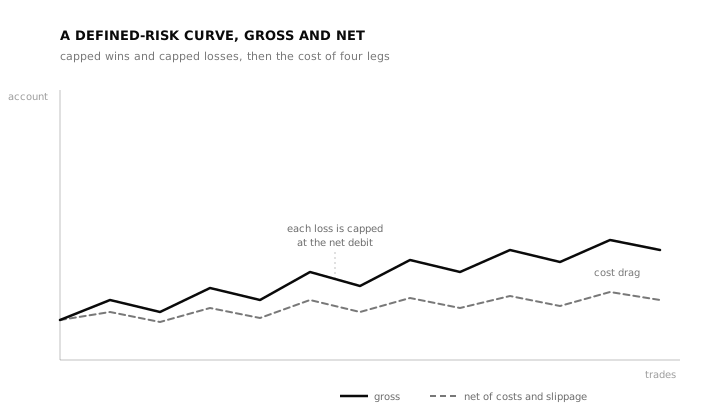
Figure 2: A defined-risk equity curve moves in capped steps rather than one tail collapse, but the cost of four option legs per round trip pulls the net result well below the gross. Illustrative figures.
Liquidity is the second trap, and it lands on the short leg. Near the money the most active strikes are deep and tightly quoted, but the lower-strike put you sell may sit further from the money where trades thin out and the bid-ask spread widens. A backtest that fills both legs at the mid-price is assuming a price that the thinner leg may never have offered. Assume you buy at the ask and sell at the bid, and assume worse on the illiquid strike. Settlement is the third: index options are European-style and cash-settled, while single-stock options are European-style but physically settled. So there is no early assignment, but an in-the-money short put held to expiry can create a delivery obligation, which a backtest must model correctly. A backtest that quietly closes everything at a convenient expiry-day price is not modelling what would really have happened. The point of the exercise is a number you could have actually kept, net of every cost.
A result that does not state whether it is net of all four legs' costs is gross, and gross is not a number you can act on.How to validate it
Validation is the step that separates a real edge from a backtest fitted to the past, and it is where most candidate rules fail. A bear put spread has only a handful of dials, the two strikes, the width, the expiry, the entry filter and the exit, which makes it easy to sweep dozens of combinations and keep the one with the best historical curve. That is exactly how a rule gets fitted to the noise of one stretch of history, a trap called overfitting. Marcos López de Prado, in Advances in Financial Machine Learning, shows that the more configurations you test, the more likely the best one is luck rather than skill. The winner of a parameter sweep is the most overfit setting in the set, not the most trustworthy.
The tests that catch this are layered. The first is out-of-sample testing: hold back a slice of history the tuning never touches, fit the strikes and filters on the rest, then test once on the untouched slice. The stronger version is walk-forward analysis, shown in Figure 3, which rolls that split forward through time so the rule has to keep working as conditions change rather than having worked once. A Monte Carlo simulation then reorders the trade sequence thousands of times to show the spread of outcomes one history could have produced; for a defined-risk strategy the worst case is bounded by construction, so what Monte Carlo exposes here is not a blow-up but the depth and clustering of drawdown, the run of capped losses that can still empty an account if they land back to back.
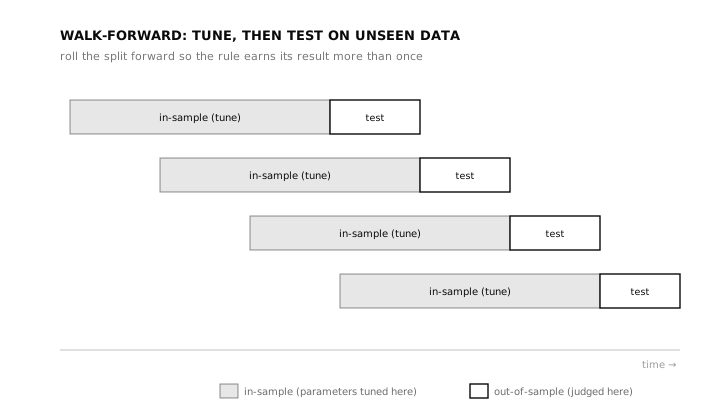
Figure 3: Walk-forward analysis tunes the spread's parameters on an in-sample window, tests them on the next unseen window, then rolls the whole split forward, so the rule must keep earning its result as conditions change. Illustrative figures.
What makes validation different for this structure is the role of volatility. A bear put spread opens for a net debit, so it is net long premium and modestly sensitive to implied volatility, the market's expectation of future movement priced into the option. Buying the spread when implied volatility is already high means paying up for the long put, and if volatility then falls the position loses value even when the direction is right, though the short leg cushions some of that. Time and direction show up through the option Greeks, the sensitivities of an option's price to the underlying, to time, and to volatility: the spread carries negative delta, so it profits as the underlying falls, but it also bleeds a little to time decay every day the move is late. An honest validation tests the rule across volatility regimes, not just the calm or the panic that happened to suit it.
An honest validation tests the rule across volatility regimes, not just the calm or the panic that happened to suit it.Limits and pitfalls
The bear put spread's limit is the mirror image of its safety. Because the loss is capped at the debit, it will not blow up the way a naked short option can, and SEBI's study of the derivatives segment, which found that 93% of individual F&O traders incurred losses between FY22 and FY24, with aggregate losses exceeding ₹1.8 lakh crore, is the backdrop against which any options strategy should be judged. That is context, not a verdict on this rule. The defined-risk structure does not make the losses go away; it caps each one and lets them recur quietly.
The real failure mode is erosion, not catastrophe. The move can simply never arrive, and time decay grinds the long put down to the breakeven and past it. You can be right on direction and still leave money on the table, because the profit is capped the moment the underlying drops below the short strike. The double set of costs eats a debit that was small to begin with. And on single-stock options the short leg invites early assignment and pin risk when the underlying settles near a strike at expiry. None of these is dramatic on any one trade, which is precisely why they need a backtest and a validation to surface. A bear put spread is a reasonable hypothesis. Honest testing is what tells a reasonable hypothesis from a tradable one.
A checklist before you trust a bear put spread strategy
Before you treat a clean payoff diagram as an edge, run the rule past a few honest questions.
| Checklist question | Why it matters |
|---|---|
| Did I define entry and exit rules before testing? | Prevents discretionary hindsight |
| Are brokerage, taxes, and slippage on all four legs included? | Prevents fantasy returns |
| Is the maximum loss, the net debit, known and acceptable per trade? | Sizes the position to survivable risk |
| Did the rule survive out-of-sample data? | Tests whether it generalises |
| Did walk-forward results stay stable? | Tests parameter robustness |
| Did Monte Carlo show survivable drawdowns? | A capped loss still empties an account if losses cluster |
| Did I test across volatility regimes and account for assignment on the short leg? | A debit spread is sensitive to implied volatility and to physical settlement and expiry risk on single-stock options |
Frequently asked questions
What is a bear put spread?
A bear put spread is a two-leg options strategy that buys a put at a higher strike and sells a put at a lower strike, both on the same underlying and the same expiry, for a net debit. It is a moderately bearish, defined-risk position: the maximum loss is the debit paid and the maximum profit is the difference between the strikes minus that debit.
Is a bear put spread bullish or bearish?
It is bearish, but only moderately. The position profits when the underlying falls, and reaches its maximum profit when the underlying finishes at or below the lower (short put) strike at expiry. It does not need a crash, only a move down to the short strike, and its gain is capped beyond that point.
What are the maximum profit and maximum loss on a bear put spread?
The maximum loss is the net debit paid to open the spread, incurred if the underlying finishes at or above the higher (long put) strike. The maximum profit is the distance between the two strikes minus that debit, reached if the underlying finishes at or below the lower strike.
Is a bear put spread a defined-risk strategy?
Yes. Both the maximum profit and the maximum loss are finite and known at entry, and the position cannot lose more than the net debit paid for it. This is the deliberate contrast with selling a naked put or a straddle, where the potential loss is open-ended. The trade-off is that the upside is capped too.
What is the breakeven on a bear put spread?
There is a single breakeven: the higher (long put) strike minus the net debit paid. Below that price at expiry the position is in profit, up to its cap; above it the position is in loss, up to the debit.
Is a backtested bear put spread result a prediction of future returns?
No. A backtest describes how a rule behaved on historical data under stated assumptions. Past performance does not guarantee future results, and live conditions, option spreads, costs, and volatility regimes can differ sharply from the test. This article is educational and not advice to trade the strategy.
The neatness of a bear put spread, a known gain, a known loss, a single breakeven drawn before the trade is on, is exactly why it deserves the same testing as anything riskier rather than a screenshot of one good month. A payoff that looks decisive on a diagram is a hypothesis until it survives data it has never seen, net of every leg's cost, with its drawdowns made visible. That survival is what daZh by Zudora is built to test: a no-code platform where a vertical spread like this can be specified with a visual leg configurator, backtested across history, then put through parameter optimisation, walk-forward analysis, overfitting detection, and Monte Carlo validation before any capital is committed.
Related guides
- Bull call spread strategy: build, backtest, and validate it
- Iron condor strategy and the butterfly option strategy
- Implied volatility and the option Greeks
- Walk-forward analysis, out-of-sample testing, and Monte Carlo simulation
- Pillar: How to backtest an options strategy
Disclaimer: daZh is a software platform for building, testing, and managing user-defined trading strategies. It does not provide investment advice, stock recommendations, guaranteed returns, or profit assurance. Backtests are based on historical data and assumptions; actual trading results may differ.
Sources
- The Options Industry Council (OIC), "Bear Put Spread", options strategy reference (leg structure, net debit, maximum profit, maximum loss, breakeven, defined risk). https://www.optionseducation.org/strategies/all-strategies/bear-put-spread
- John C. Hull, "Options, Futures, and Other Derivatives", 10th edition, Pearson, 2018 (bear spread created with puts: long higher-strike put, short lower-strike put). https://www.pearson.com/en-us/subject-catalog/p/Hull-Options-Futures-and-Other-Derivatives-10th-Edition/P200000008765/9780134631493
- CFA Institute, "Backtesting and Simulation", CFA Program refresher reading, 2026 curriculum. https://www.cfainstitute.org/insights/professional-learning/refresher-readings/2026/backtesting-and-simulation
- Marcos López de Prado, "Advances in Financial Machine Learning", Wiley, 2018 (backtest overfitting and the cost of multiple testing). https://www.wiley.com/en-us/Advances+in+Financial+Machine+Learning-p-9781119482086
- SEBI, "Updated study reveals 93% of individual traders incurred losses in equity F&O (FY22 to FY24); aggregate losses exceed ₹1.8 lakh crore", press release, September 23, 2024. https://www.sebi.gov.in/media-and-notifications/press-releases/sep-2024/updated-sebi-study-reveals-93-of-individual-traders-incurred-losses-in-equity-fando-between-fy22-and-fy24-aggregate-losses-exceed-1-8-lakh-crores-over-three-years_86906.html