Before risking money on a trading idea, most people reach for one of two tests. They backtest the idea against historical data, or they paper trade it in real time without real money. The two are spoken of as if they were the same precaution. They are not.
Framed honestly, paper trading vs backtesting is not a choice between two names for the same check. Each answers a different question. A backtest asks whether a fully specified set of rules would have had an edge over the past. Paper trading asks whether you can actually run those rules as the market moves, without freezing, fat-fingering an order, or quietly abandoning the plan. Confuse the two and you can pass the test you did not need while failing the one you did.
The stakes are not abstract. SEBI found that 93% of individual traders in the equity futures and options segment lost money between FY22 and FY24, with aggregate losses above ₹1.8 lakh crore. Knowing what a test can and cannot tell you is part of what separates a checked idea from a hopeful one.
What backtesting actually measures
Backtesting runs a defined strategy, its entry, exit, position sizing, and cost assumptions, across historical data, and reports how that exact rule set would have behaved had it been run unchanged.
Its strength is reach. Years of market conditions resolve in seconds, with every rule made explicit. Its weakness is that the past is fixed and known, and a known past invites two mistakes.
The first is overfitting. Tune enough parameters and you can fit a strategy to the noise of history rather than any real signal. Researchers have shown that a small number of strategy variations, tried against the same data, can produce a backtest that looks excellent purely by chance.
Tune enough parameters and you can fit a strategy to the noise of history rather than any real signal.The second mistake is hidden hindsight. A test can carry look-ahead bias, where information that was not available at the time leaks in, and survivorship bias, where instruments that failed have quietly dropped out of the data. A backtest is only as honest as its assumptions, and the most expensive assumptions are about cost. Brokerage, taxes, and slippage, the gap between the price you expect and the price you actually get, compound against every trade. SEBI's study found individual traders in this segment paid about ₹50,000 crore in transaction costs between FY22 and FY24; a backtest that ignores them is measuring an edge it could never have captured.
A backtest is only as honest as its assumptions, and the most expensive assumptions are about cost.What paper trading actually measures
Paper trading, also called forward testing or simulated trading, runs the strategy in real time on live prices, but with imaginary money. Where a backtest replays the past, paper trading moves at the speed of the present.
Its strength is exactly what a backtest cannot reach: execution and behaviour. Can you place the orders the rules demand, on time, day after day? Do you follow the system when it is losing? Paper trading surfaces the gap between a strategy on paper and a person operating it.
Paper trading surfaces the gap between a strategy on paper and a person operating it.Its blind spot is that nothing is real. A simulated order often fills at a price a live order would have missed, with no genuine slippage and no impact from your own size. And the variable that matters most is absent, which is money. A position that costs nothing to hold is easy to hold. The discipline paper trading seems to prove can vanish the moment real capital, and real loss, are on the line.
A worked example, and what to track
Consider a simple moving-average crossover, the kind of strategy that backtests cleanly. A trader runs it on paper for a month to confirm the execution holds. The log tells a more useful story than the equity curve does. The simulated fills land at each candle's close, but a live order in those moments would have chased a moving price. Two signals fire in the middle of the working day and go untaken, because no one is watching the screen. On the third losing day, the stop is widened once, "just this time". None of those events show up in a backtest, and every one of them would shape a live result.
That is why a paper-trading run is only as useful as what you record during it. The aim is not to admire the final number, but to capture, as they happen, the things a backtest cannot see.
A paper-trading run is only as useful as what you record during it.What to track during paper trading:
- Signal time, the moment each rule actually fired, so you can see whether you were even at the screen to act on it.
- The intended order price, the level the rule meant to trade at.
- The simulated fill price, what the run actually gave you, so the two can be checked later against realistic live slippage.
- Missed trades, the signals you did not take, with the reason beside each.
- Rule violations, every time you skipped, widened, or overrode a rule by hand.
- Maximum drawdown, the deepest peak-to-trough loss over the run.
- The number of manual overrides, because a system you keep correcting by hand is not the system you tested.
- Whether the results still resemble the backtest, or have quietly drifted from it.
Read together, these turn a vague sense that it "worked" or "did not" into specific findings you can act on. If the simulated fills flatter you, live results will be worse. If the overrides pile up, you have not yet tested a system you can actually follow. And if the paper run no longer resembles the backtest, one of the two is wrong, and now is the cheap time to find out.
Paper trading vs backtesting: the differences that matter
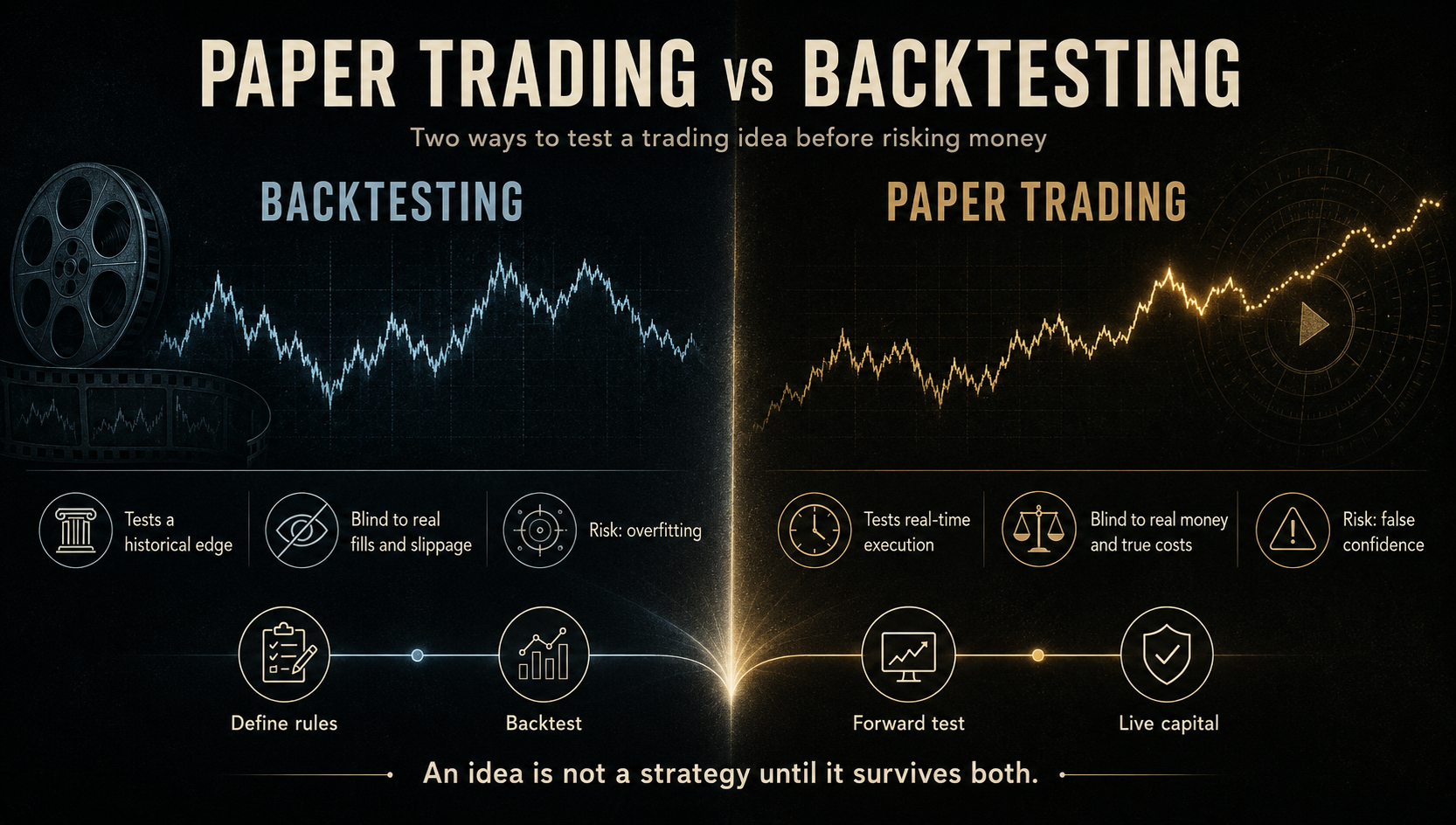
Set side by side, the two tests divide cleanly. They use different data, expose different risks, and answer different questions. Figure 1 sets them against each other.

Figure 1: A backtest replays a fixed past; paper trading follows the live present. Each sees what the other cannot.
| Dimension | Backtesting | Paper trading |
|---|---|---|
| What it tests | Whether a defined rule set had a historical edge | Whether you can execute the rules in real time |
| Data | Historical | Live, in the present |
| Speed | Years compressed into seconds | Real time only |
| Costs | Modelled, and only as honest as the model | Often unrealistic; no true slippage or fills |
| Main risk | Overfitting and hindsight bias | False confidence; no money at stake |
| Cannot show | Whether you can actually run it | Whether the edge survives real costs and history |
Read this way, the question of which is better dissolves. They are not competitors. A strategy can pass one and fail the other, and a trader who runs only the convenient test learns the wrong lesson.
They are not competitors. A strategy can pass one and fail the other.Where each fits before live capital
Validation is a sequence, not a single gate. Figure 2 shows the order. An idea is first written as explicit rules. Then it is backtested, with realistic costs, to ask whether it ever had an edge and how it held up across different conditions. Only what survives that is worth forward testing, paper trading in real time to confirm the execution and the discipline hold. The same sequence is what changes when a strategy finally goes live.

Figure 2: Validation as a sequence. Each step removes a different doubt before any capital is committed.
Even then, neither test is a promise. A backtest describes the past; paper trading describes a rehearsal without stakes. Both narrow uncertainty; neither erases it. What they remove is the worst way to discover a flaw, which is with live money in a falling market. That is the whole point of strategy validation: to be surprised on paper instead of in the account.
The useful habit is not to pick a side but to ask, of any test, what question it answers. A backtest that ignores costs answers a question no live trader faces. A paper-trading run that fills every order perfectly answers a question the market never asks. Validation means matching the test to the doubt.
An idea is not a strategy until it has survived both kinds of test. Putting that validation between a trading idea and live capital, so the doubts get resolved before the money does, is what daZh by Zudora is built around. A test cannot promise the next trade. But running the right one is how a trader stops guessing and starts validating.
Disclaimer: daZh is a software platform for building, testing, and managing user-defined trading strategies. It does not provide investment advice, stock recommendations, guaranteed returns, or profit assurance. Backtests are based on historical data and assumptions; actual trading results may differ.
Sources
- SEBI, "Updated study reveals 93% of individual traders incurred losses in Equity F&O between FY22 and FY24; aggregate losses exceed ₹1.8 lakh crore over three years", press release, September 23, 2024. https://www.sebi.gov.in/media-and-notifications/press-releases/sep-2024/updated-sebi-study-reveals-93-of-individual-traders-incurred-losses-in-equity-fando-between-fy22-and-fy24-aggregate-losses-exceed-1-8-lakh-crores-over-three-years_86906.html
- SEBI, "Analysis of Profits and Losses in the Equity Derivatives Segment (FY22-FY24)", study, September 23, 2024. https://www.sebi.gov.in/reports-and-statistics/research/sep-2024/study-analysis-of-profits-and-losses-in-the-equity-derivatives-segment-fy22-fy24-_86905.html
- David H. Bailey, Jonathan M. Borwein, Marcos López de Prado, Qiji Jim Zhu, "Pseudo-Mathematics and Financial Charlatanism: The Effects of Backtest Overfitting on Out-of-Sample Performance", Notices of the American Mathematical Society, May 2014. https://papers.ssrn.com/sol3/papers.cfm?abstract_id=2308659
- CFA Institute, "Backtesting and Simulation", CFA Program refresher reading, 2026 curriculum. https://www.cfainstitute.org/insights/professional-learning/refresher-readings/2026/backtesting-and-simulation
- Investopedia, "Paper Trade", orientation reference, accessed June 2026. https://www.investopedia.com/terms/p/papertrade.asp