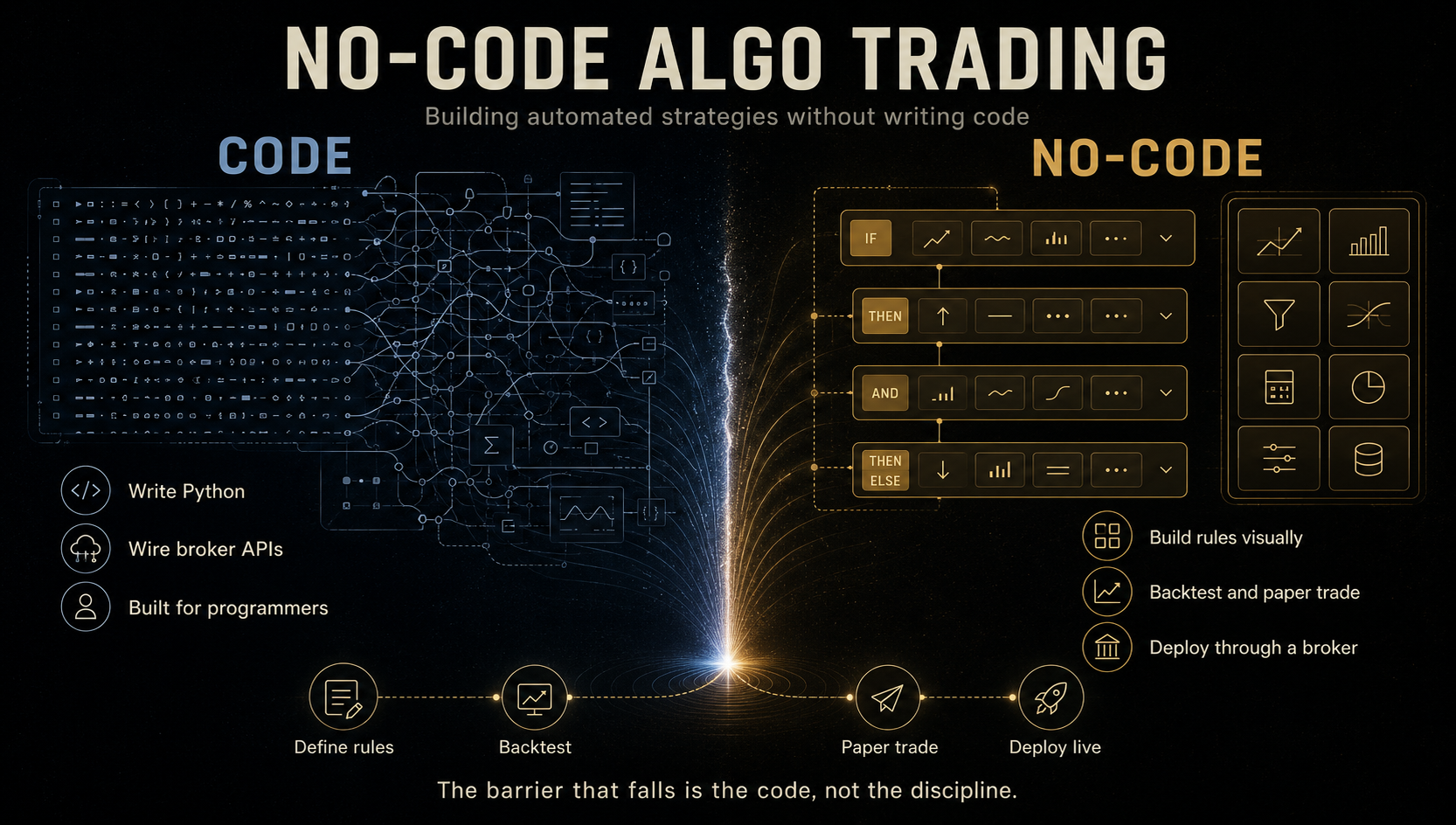
No-code algo trading lets a trader turn a set of rules into a strategy that runs on its own, without writing a single line of code. The rules are assembled in a visual interface, through menus and clicks rather than a programming language, then tested against historical data and, once a broker account is connected, routed through a broker-supervised workflow, where applicable, before reaching the market.
For most of its history, that kind of automation was out of reach for an individual. It needed programming skill, a way into the exchange, and the infrastructure to run code against a live market. The markets regulator, SEBI, defines algorithmic trading plainly, as "orders generated using automated execution logic", and for years that logic was the preserve of institutions and the handful of retail traders who could code.
The scale is no longer marginal. Algorithmic orders rose from 37% of cash-market turnover in FY15 to 53% in the first ten months of FY25, and reached about 70% of equity-derivatives notional turnover over the same stretch, according to the National Stock Exchange. Automation is now how a large share of the market trades. No-code tools are what let someone take part in that without first becoming a programmer.
What no-code algo trading is
A no-code algo platform replaces the code with a visual builder, not the discipline behind it. Instead of writing a program, the trader selects conditions from a menu: an indicator, a price level, a time of day, a position size. Those conditions become the entry and exit rules of a strategy that the platform can run automatically.
The strategy is rule-based, which is the heart of the idea. A finished rule set is just an explicit set of instructions. One might read: buy when the relative strength index falls below 30 and price closes above the volume-weighted average price, exit when that index crosses back above 50 or a 1.5% stop loss is hit, and square off before the close. The relative strength index and the volume-weighted average price are indicators, calculations derived from price or volume that the rules read. In a no-code builder, each of those conditions is a menu selection rather than a line of code, and nothing is left to discretion once the strategy is running. The trader's judgement goes into the rules; the execution follows them exactly.
A no-code algo platform replaces the code with a visual builder, not the discipline behind it.That is the same logic an institutional desk has always used. The difference is who can author it. Where a quantitative analyst would express these rules in Python, a no-code builder expresses them in a form anyone can read and change.
How it works: build, backtest, deploy
A no-code strategy moves through three stages before it trades real money. Figure 1 shows the path.

Figure 1: The no-code workflow, from rule definition to live deployment.
The first stage is building. The trader defines the rules and indicators in the visual interface, setting the conditions for entry, exit, position sizing, and risk limits.
The second stage is backtesting, and it is where most of the work sits. Backtesting runs the strategy against historical data to answer a single question, which the CFA Institute frames as "how would this strategy have performed if it were implemented in the past". The platform replays past market data through the rules and reports what the strategy would have done: its returns, its worst losing streak, how often it traded. Many traders then move to paper trading, running the strategy on live prices with simulated money, to see it behave in current conditions before any capital is at stake.
The third stage is deployment. When enabled through the required broker and regulatory workflow, the strategy can be routed for live execution, placing orders according to its rules rather than by hand. This is the step that used to require code, because the strategy has to speak to the exchange through the broker's systems. The connection now runs through a broker's application programming interface, or API, the channel that lets external software place orders, exposed by broker products such as Zerodha's Kite Connect. SEBI's 2025 retail framework is built around exactly this API route. A no-code platform manages the connection so the trader does not have to.
White box and black box
Not every automated strategy is equally transparent, and the distinction has now been written into the rules. SEBI's framework separates algorithms into two kinds. A white box, or execution algorithm, is one where "the logic, decision making processes and underlying rules are accessible and understandable to users". A black box is the opposite: an algorithm whose internal workings the user cannot see and cannot reproduce.

Figure 2: White box and black box algorithms differ in whether the trader can see the logic.
The difference matters more than it first appears. With a white box, every rule is visible and can be changed, questioned, or tested. With a black box, the trader is acting on output they cannot inspect. A white box can be read; a black box can only be trusted.
A white box can be read; a black box can only be trusted.Most no-code builders are white boxes by design, because the trader assembles the rules themselves and can see each one. That visibility is the quiet advantage of the no-code approach. The point of removing the code is not only convenience; it is that the strategy stays legible to the person running it.
Code, no-code, and why retail traders can now do this
The two paths to automation differ in what they ask of the trader. The code path uses a programming language, usually Python, wired to a broker's API; it is flexible and unbounded, and it assumes the trader can program. The no-code path trades some of that flexibility for access: the visual builder handles the rules and the broker connection, and the trader supplies the strategy.
What changed is the regulatory ground beneath both. Automated market access began as an institutional facility. When SEBI introduced Direct Market Access in 2008, the permission was "restricted to institutional clients". Retail traders who automated did so informally, through broker APIs and third-party tools, outside a dedicated framework.
That gap is now being closed. In February 2025, citing "an increasing demand for algo trading by retail investors", SEBI issued a framework for safer retail participation in algorithmic trading. It makes the broker the principal for any algo routed through its API, requires each algorithm to be registered with the exchange and tagged with a unique identifier, and sets out the white box and black box categories above. The framework took full effect on April 1, 2026. For the first time, a retail trader running an automated strategy does so inside a defined, supervised structure rather than around the edges of one.
The technology makes a systematic strategy possible to build; the framework defines how it may be run through supervised broker and exchange workflows.So no-code algo trading is best understood as two shifts arriving together. A visual layer removes the need to code, and a regulatory framework brings automated trading into reach for the retail trader under clear rules. The technology makes a systematic strategy possible to build; the framework defines how it may be run through supervised broker and exchange workflows.
From easy to build to ready to run
What no-code does well is lower the cost of trying. A strategy that once took a programmer and a week can be sketched in an afternoon and tested in minutes. That is a real change, and it is the reason the category exists.
It is worth being precise about what it changes. The barrier that is falling is the programming barrier, not the one between a tested idea and a live one. A visual builder makes a strategy easy to assemble. Whether that strategy is any good is a separate question, and a harder one, that no amount of convenience answers.
The barrier that is falling is the programming barrier, not the one between a tested idea and a live one.That gap, between an idea that looks good on a historical chart and one ready for real capital, is where daZh by Zudora works. It is a no-code platform built as the validation layer between a trading idea and live capital: a place to build a strategy without writing code, and to examine how it behaves, in detail, before anything reaches the market.
Disclaimer: daZh is a software platform for building, testing, and managing user-defined trading strategies. It does not provide investment advice, stock recommendations, guaranteed returns, or profit assurance. Backtests are based on historical data and assumptions; actual trading results may differ.
Sources
- SEBI, "Broad Guidelines on Algorithmic Trading", circular CIR/MRD/DP/09/2012, March 30, 2012. https://www.sebi.gov.in/legal/circulars/mar-2012/broad-guidelines-on-algorithmic-trading_22471.html
- National Stock Exchange, "Market Pulse", Volume 7, Issue 2, February 2025 (algorithmic share of cash-market turnover and equity-derivatives notional turnover). https://nsearchives.nseindia.com/web/sites/default/files/inline-files/Market%20Pulse_February_2025.pdf
- CFA Institute, "Backtesting and Simulation", 2026 curriculum refresher reading. https://www.cfainstitute.org/insights/professional-learning/refresher-readings/2026/backtesting-and-simulation
- Zerodha, "A comprehensive overview of NSE's circular on the new retail algo trading framework", Z-Connect, May 6, 2025. https://zerodha.com/z-connect/general/a-comprehensive-overview-of-nses-circular-on-the-new-retail-algo-trading-framework
- SEBI, "Safer participation of retail investors in Algorithmic trading", circular SEBI/HO/MIRSD/MIRSD-PoD/P/CIR/2025/0000013, February 4, 2025 (white box and black box categories; broker-as-principal; demand for retail algo). https://www.sebi.gov.in/legal/circulars/feb-2025/safer-participation-of-retail-investors-in-algorithmic-trading_91614.html
- SEBI, "Introduction of Direct Market Access facility", circular MRD/DoP/SE/Cir-7/2008, April 3, 2008 (permission initially restricted to institutional clients). https://www.sebi.gov.in/legal/circulars/apr-2008/introduction-of-direct-market-access-facility_6465.html
- SEBI, "Extension of timeline for implementation of SEBI Circular dated February 04, 2025 on Safer participation of retail investors in Algorithmic trading", circular SEBI/HO/MIRSD/MIRSD-PoD/P/CIR/2025/132, September 30, 2025 (full applicability from April 1, 2026). https://www.sebi.gov.in/legal/circulars/sep-2025/extension-of-timeline-for-implementation-of-sebi-circular-dated-february-04-2025-on-safer-participation-of-retail-investors-in-algorithmic-trading-_96979.html