A backtest can quietly cheat. A strategy ranks stocks each quarter by their latest earnings growth, rebalances on the last trading day of the quarter, and the equity curve climbs at a slope that looks too clean to be real. It is too clean. On the day the strategy acted on those earnings, no company had reported them yet; the results would not reach the market for another month. The backtest has been reading the future, and the name for that is look-ahead bias.
Definition
"Look-ahead bias is the use of information in a backtest that would not have been available at the moment the strategy acted, so the test draws on knowledge the market did not yet have."
The bias is one of the classic failures the CFA Institute flags in its work on backtesting and simulation, where it lists survivorship bias and look-ahead bias among the behavioural issues a backtester has to watch for. In the CFA Program curriculum the bias is described as the use of information that was not available during the historical period being tested, and it is treated as the most common mistake in backtesting. The mechanism is always the same: a decision is taken at a point in time using data that, in reality, only arrived later.
That single sentence hides a lot of ways to go wrong. The leaked information can be a corporate earnings figure, a restated balance sheet, the final value of an index after its membership was revised, or something as small as the closing price of the very bar on which a signal claims to have traded. In each case the backtest grants the strategy a glimpse of data it could not have seen, and the strategy, being a machine that maximises against whatever it is shown, happily turns that glimpse into profit.
The backtest has been reading the future, and the name for that is look-ahead bias.What look-ahead bias actually is
Every backtest is a re-enactment. It walks through history one period at a time and asks, at each step, what the strategy would have done with the information available then. Look-ahead bias is what happens when that "available then" quietly becomes "available now". The re-enactment stops being faithful to the past and starts borrowing from a vantage point no trader ever occupied: the present, looking back.
The damage is that the borrowed knowledge is almost always useful. Knowing an earnings surprise before it is announced, knowing which firms will still be in the index next year, knowing where a bar closes before deciding to trade inside it, each of these is a small edge that no real account could have captured. A leaked backtest is not measuring a strategy, it is measuring a strategy plus a time machine. The headline return belongs partly to the idea and partly to the leak, and nothing on the equity curve tells you the split.
A leaked backtest is not measuring a strategy, it is measuring a strategy plus a time machine.This is also why look-ahead bias is more insidious than a simple coding error. An obvious bug produces an obviously broken result. A leak produces a beautiful one. As Marcos Lopez de Prado puts it in his 2018 work on financial machine learning, a backtest is not an experiment, and it does not prove anything; even a flawless-looking simulation can be wrong for reasons that never surface on the chart. Look-ahead bias is one of the cleanest ways for a simulation to look flawless and be wrong at the same time.
How the future leaks into a backtest
The leak rarely arrives as one dramatic mistake. It seeps in through ordinary data-handling choices, each defensible on its own. A handful of sources account for most cases.
| Source | What leaks in | When the data was really available |
|---|---|---|
| Quarterly earnings | Results used on the quarter-end date | Roughly four to six weeks later, on the announcement |
| Restated financials | A later, revised figure used for an earlier date | Months or years after the original print |
| Index membership | Today's constituents assumed for past dates | Only after each addition or removal took effect |
| Same-bar execution | A signal computed on a bar's close, filled at that close | The close is only known once the bar has ended |
| Macro data revisions | Final GDP or inflation prints used for the first-release date | After one or more official revisions |
Illustrative figures.
The most common version is the reporting lag. Fundamental data is dated to the period it describes, not the day it became public. A March-quarter result is stamped "March", but it is announced in April or May. A backtest that joins that figure to the March-end date, and then rebalances on it, is acting on information that did not exist for weeks. Corporate Finance Institute uses exactly this case as its textbook example: a model that assumed earnings reports were available on the same date the fiscal quarter ended, when in reality they landed about a month later.
Restatements are a subtler cousin. Companies and statistical agencies revise their numbers, and a database that overwrites the original figure with the corrected one hands the backtest a version of history that traders never saw. The same applies to index membership: testing a strategy on the stocks that are in an index today, rather than the stocks that were in it on each historical date, quietly assumes you knew in advance which names would be promoted and which would be dropped.
Figure 1 shows the core of the problem on a single timeline. A decision is taken at time T, but the data the strategy used to make it only became available at a later time, T plus a lag. The arrow that runs backwards, from the later data to the earlier decision, is the bias itself.
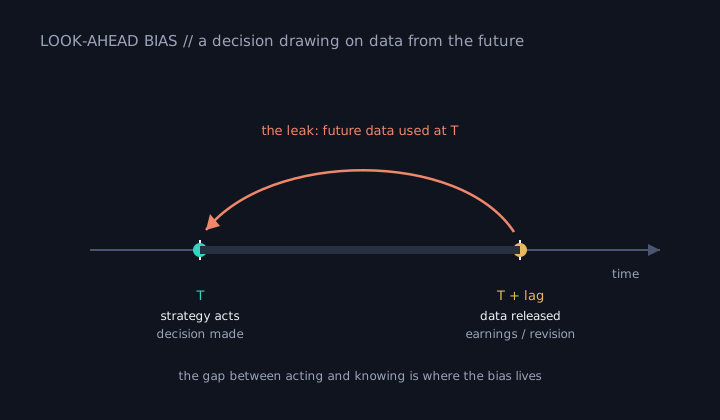
Figure 1: Look-ahead bias as a backwards arrow in time. The strategy acts at T using information that only existed at T plus a lag, so the decision draws on the future. Schematic, illustrative.
Figure 2 plots the lag column from the table above, the gap between when each kind of data is dated and when it could actually be used. The longer the bar, the more future a careless join lets the strategy borrow.
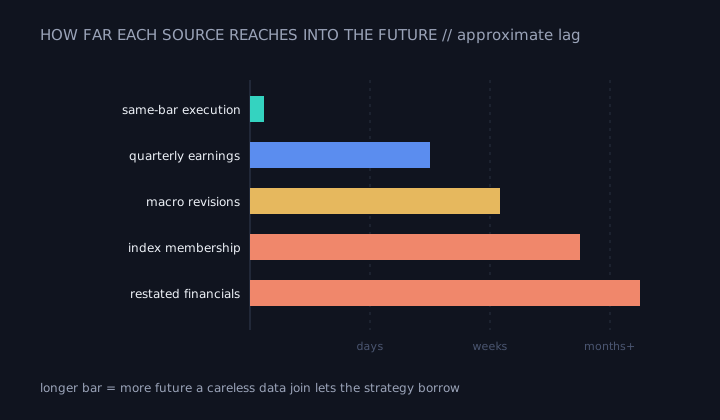
Figure 2: How far each source reaches into the future. Same-bar execution leaks only the rest of one bar; earnings leak weeks; restatements and membership changes can leak months or years. Schematic lags, illustrative.
Why a leaked backtest looks brilliant
The reason look-ahead bias is dangerous is that its symptom is success. The strategy is being scored partly on information it could never have traded on, so the score is too high, and a too-high score is the one result a trader is least inclined to question. The equity curve does not wobble or warn; it simply rises more smoothly and more steeply than the live version ever could.
Set the same idea side by side, run once with the leak and once on point-in-time data, and the gap is stark. Consider a rule that rebalances a ₹10 lakh book each quarter into the highest-earnings-growth names on the NSE.
| Metric | Leaked backtest | Point-in-time backtest |
|---|---|---|
| Information used | Earnings on the quarter-end date | Earnings on the announcement date |
| Annual return | 34% | 16% |
| Win rate | 71% | 54% |
| Worst drawdown | 12% | 27% |
| What it reflects | Idea plus a one-month look-ahead | The idea alone |
Illustrative figures, not a real strategy or a recommendation.
The leaked column is the one a trader would want to fund, and it is the one that cannot be reproduced. The whole difference between the two is timing: the same instruments, the same rule, the same period, separated only by whether the strategy was allowed to act on numbers before they were public. Figure 3 shows the two equity curves diverging from the same starting capital, the leaked path pulling away on an edge that does not exist outside the simulation.
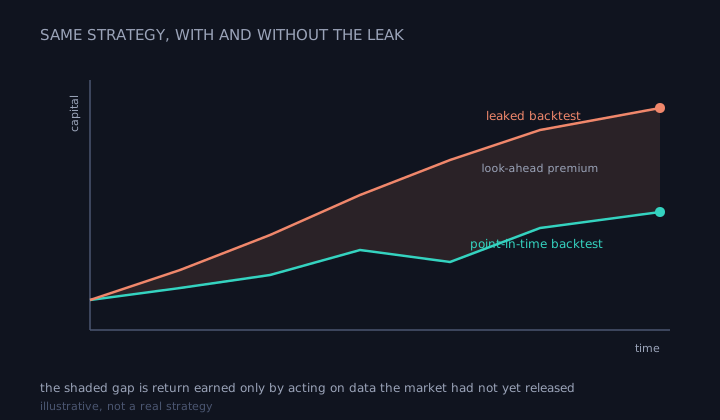
Figure 3: The same strategy, with and without the leak. The gap between the curves is the part of the return that came from acting on information the market had not yet released. Illustrative figures, not a real strategy.
This is why look-ahead bias belongs with overfitting and survivorship bias as a way a backtest can flatter an idea into looking fundable. The three are different mechanisms, fitting noise, dropping the failures, and borrowing the future, but they share one effect: a result that is better than the strategy, and worse than it looks.
Catching it: point-in-time data and a more honest clock
The cure is not a cleverer model but a more honest clock. Every input has to be stamped with the date it was genuinely knowable, and the backtest has to refuse to use anything before that stamp.
The cleanest defence is point-in-time data: a record of what each figure was, as of each historical date, including the lag before it was released and any later revisions kept separate from the original print. Point-in-time data asks a stricter question: what did the market actually know on this date? A backtest fed point-in-time fundamentals cannot use March earnings in March, because the dataset does not show them as known until May. The same discipline applies to execution. A signal computed from a bar's close cannot be filled at that same close, because the close is not known until the bar is over, unless the strategy's rules explicitly assume execution after the close at a realistic next available price, such as the next bar's open.
Point-in-time data asks a stricter question: what did the market actually know on this date?For strategies built with machine learning, the leak can hide inside the validation procedure rather than the data feed. When a model is trained and tested on overlapping time windows, the test period can share information with the training period, and the model effectively studies for an exam it will later sit. Lopez de Prado's answer is purging: in purged cross-validation, any training observation whose outcome overlaps in time with the test set is removed, so the model is never judged on a period it has already glimpsed. It is the same principle as point-in-time data, applied to the seam between learning and testing rather than between data and decision.
The cure is not a cleverer model but a more honest clock.None of this makes a strategy better. It makes the measurement honest, which usually means lower. A return that falls when you switch to point-in-time data was never fully real; the part that vanished was the part the leak was paying for. That discomfort is the signal working, the same way an out-of-sample result that disappoints is strategy validation doing its job rather than failing at it.
Common places look-ahead bias hides
Most leaks hide in a few familiar places, and knowing them turns the search from guesswork into a quick scan.
| Place it hides | The mistake |
|---|---|
| Fundamental data | Using quarter-end data before the announcement date |
| Candle data | Computing a signal from the close and filling at that same close |
| Indicators | Using a rolling value that accidentally includes future bars |
| ML labels | Training on outcomes that overlap with the test period |
| Constituents | Testing past returns using today's index members |
| Revised data | Using final revised figures instead of first-published figures |
A checklist to catch look-ahead bias
Before trusting a backtest, ask where the future might have leaked in:
- Is every fundamental input stamped with its real release date, not the period it describes?
- Are restated or revised figures kept separate from what was first published?
- Does the test use the index constituents that were live on each date, not today's list?
- Is a signal computed on a bar ever filled at that same bar's price?
- Are realistic delays built in between a signal, an order, and a fill?
- For machine-learning models, do the training and test windows overlap in time?
- Did the return drop when you moved from convenient data to point-in-time data, and can you account for the gap?
A strategy needs realistic timing built into the test that judges it, not added as an afterthought once a curve looks good. Every signal acting only on information that existed at that instant, every fill priced at what a real order would have paid, and every model judged on data it has never glimpsed, are part of putting validation between a trading idea and live capital. That is the layer daZh by Zudora is built to be: a place to test an idea against history on terms a live account would actually have faced, so an edge that depends on reading the future is exposed before any money is at stake. A backtest can describe the past, but only an honest clock decides whether that description was ever reproducible.
Frequently asked questions
What is look-ahead bias in backtesting?
Look-ahead bias is using information in a backtest that would not have been available when the strategy acted, so the test draws on knowledge the market did not yet have. It inflates a result that live trading cannot reproduce.
What is an example of look-ahead bias?
A strategy that ranks stocks by quarterly earnings and acts on them at the quarter-end date, when the results were not announced until weeks later. The backtest trades on numbers that did not yet exist.
How do you avoid look-ahead bias?
Use point-in-time data stamped with the date each figure was genuinely knowable, build realistic delays between a signal and its fill, and keep later revisions separate from what was first published.
Is same-bar execution look-ahead bias?
Yes, if a signal is computed from a bar's close and then filled at that same close, because the close is not known until the bar has ended. A realistic fill is the next bar's open, or later.
What is point-in-time data?
Point-in-time data records what each figure was as of each historical date, including its release lag and keeping later revisions separate, so a backtest only sees what the market actually knew on that date.
How is look-ahead bias different from survivorship bias?
Look-ahead bias borrows future information for a past decision; survivorship bias drops the failures from the historical record. Both flatter a backtest, but one is about timing and the other about which names are in the sample.
Related concepts
- Survivorship bias, the companion data bias that drops the failures from the record.
- Overfitting, fitting the noise of one history sample rather than a real signal.
- Out-of-sample testing, judging a strategy on data it was never built on.
- Strategy validation, the full sequence look-ahead bias quietly corrupts.
- How to Backtest an Options Strategy.
Disclaimer: daZh is a software platform for building, testing, and managing user-defined trading strategies. It does not provide investment advice, stock recommendations, guaranteed returns, or profit assurance. Backtests are based on historical data and assumptions; actual trading results may differ.
Sources
- CFA Institute, "Backtesting and Simulation", CFA Program refresher reading, 2026 curriculum. https://www.cfainstitute.org/insights/professional-learning/refresher-readings/2026/backtesting-and-simulation
- Marcos Lopez de Prado, "Advances in Financial Machine Learning", John Wiley & Sons, 2018, Chapter 11, "The Dangers of Backtesting" (ISBN 978-1-119-48208-6). https://www.oreilly.com/library/view/advances-in-financial/9781119482086/c11.xhtml
- Marcos Lopez de Prado, "Advances in Financial Machine Learning", John Wiley & Sons, 2018, Chapter 7, "Cross-Validation in Finance" (purged k-fold cross-validation and the embargo). https://www.oreilly.com/library/view/advances-in-financial/9781119482086/c07.xhtml
- Corporate Finance Institute, "Look-Ahead Bias, Definition and Practical Example" (orientation, for the quarterly-earnings example). https://corporatefinanceinstitute.com/resources/career-map/sell-side/capital-markets/look-ahead-bias/