Learning how to start algo trading is less about a single decision and more about a sequence. The steps run in order: set expectations, pick what to trade, choose your tools, build a strategy, test it, validate it, paper trade it, and only then route it to the market with real money. Most beginners rush the middle and pay for it later. The step that decides whether a trader lasts is not the first automated order; it is the validation that comes before it.
None of this needs code anymore, and the regulatory ground is now defined. The harder truth is simpler. The tools make a strategy easy to build, not easy to make work. This guide walks the path a beginner should actually follow, and is honest about where the effort really pays off.
The tools make a strategy easy to build, not easy to make work.Figure 1 lays out the full path.
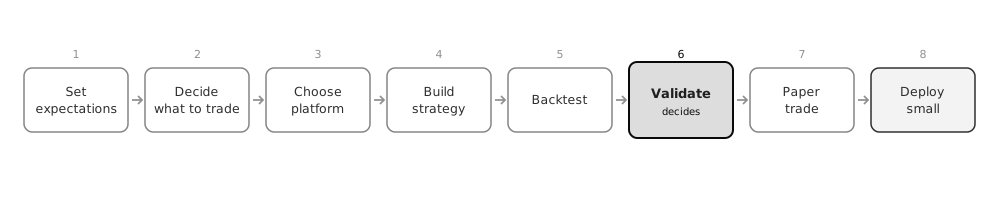
Figure 1: The path from idea to a live strategy, with validation marked as the step that decides.
What you need before you start
A short checklist of what to have in place before the first step. None of it is expensive, and most no-code platforms bundle the middle items.
| What you need | What it means |
|---|---|
| A broker account | One that supports the algo workflow you intend to use |
| One market to focus on | Start with a single market rather than several |
| A simple strategy idea | A rule you can state clearly in a sentence |
| Historical data | Past price data to backtest the rule against |
| A backtesting platform | To test the strategy before any capital is used |
| A risk limit | A maximum loss you will accept per trade, per day, and overall |
| A paper-trading setup | To rehearse on live prices before going live |
With those in place, the steps below run in order.
Step 1: Start with realistic expectations
Before any tool, set the frame correctly. Algorithmic trading, which SEBI defines as "orders generated using automated execution logic", executes rules without emotion. It is not a money machine. Automation follows whatever rule it is given, so it runs a poor strategy as faithfully as a good one, and it cannot guarantee profit. Treat any promise that it does as a warning sign.
The realistic goal for a beginner is not a big first month. Aim for a process you can trust: a strategy you understand, tested honestly, run at a size that cannot hurt you while you learn. Set that expectation now and the rest of the steps make sense.
Step 2: Decide what you will trade, and how
Narrow the field before building anything. Pick one market to start, equities or index options, and one strategy style rather than several at once. The two most accessible for a beginner are trend-following, which trades in the direction of a confirmed move, and mean-reversion, which trades when price stretches too far from an average and is expected to return. Start with equities if you can. Index options deserve smaller size and more testing than equities, because leverage, expiry, spreads, and execution costs can make a mistake compound faster.
Keep the first idea simple enough to state in a sentence. A rule you can say plainly is far easier to test and trust than a tangle of conditions, and complexity is easy to add later and hard to debug early.
Step 3: Choose your platform and broker
The tools come in two kinds. The code route uses a language, usually Python, wired to a broker's application programming interface, or API, the channel that lets software place orders; it is powerful but assumes you can program. The no-code route replaces the code with a visual builder, so you assemble the rules through menus and the platform handles the wiring.
For a beginner, the no-code route removes the barrier that used to stop most people before they began. What to look for in a platform is less about flashy features and more about whether it lets you test properly. The essentials are honest backtesting, validation tools, and clear risk controls. A no-code platform such as daZh by Zudora is built around exactly that testing layer.
What to look for in a platform is less about flashy features and more about whether it lets you test properly.Step 4: Build a simple, complete strategy
Build the first strategy completely, not just its entry signal. Specify what opens a position, what closes it, the position size, the risk limits such as a stop-loss, the instruments it trades, and any time filters; the full anatomy of a strategy is worth reading once. Anything you leave to assumption is something the backtest will not check.
Make it concrete. A first rule might be: buy when price closes above its highest high of the past 20 days, a breakout, then exit on a close back below the 10-day average or a fixed 3% stop, and flatten before the session ends. That is simple enough to test, and simple enough to understand when it misbehaves.
Step 5: Backtest it honestly
Run the finished rules against history. A backtest replays past market data through the strategy and reports how it would have behaved, its returns, its worst losing streak, how often it traded, which is the question a backtest exists to answer.
The word that matters is honestly. Build in the trading costs, including brokerage and slippage, the difference between the price you plan to trade at and the price you actually get. A test that leaves them out flatters any strategy that trades often, and measures an edge you could never capture in practice.
Step 6: Validate it before you trust it
This is the step beginners skip and the one that matters most. A good backtest is not proof. A strategy can be tuned to fit the noise of one stretch of history rather than a pattern that repeats, a trap called overfitting, and Bailey and colleagues showed in the Notices of the American Mathematical Society that the more variations you test against the same data, the more likely the winner is luck.
This is the step beginners skip and the one that matters most.Guard against that with validation, which has three standard checks. Run an out-of-sample test on a slice of history the strategy never saw while you tuned it. Use walk-forward analysis to repeat that check across rolling windows, so the strategy has to keep working as conditions change. Run a Monte Carlo simulation that shuffles the trade sequence many times to show how much of the result was luck. None of the three proves a strategy will work; together they strengthen the evidence. A strategy that clears all three has earned more trust than one supported by a single flattering backtest.
Step 7: Paper trade in live conditions
A validated strategy still meets the live market for the first time eventually. Before it does so with money, run it in paper trading, placing its orders on live prices with simulated capital. This catches what history cannot show: whether the data feed and the timing behave, how the strategy acts in current conditions, and whether you can actually leave it alone. Do not judge it by one good week. A useful paper-trading run lasts long enough to include a meaningful number of trades, so you can see whether the signals, the exits, the slippage assumptions, and your own discipline behave close to the backtest.
Paper trading does not replace validation, and a strategy that failed its backtest has not earned a paper-trading run. It is the last rehearsal before anything real is at stake.
Step 8: Deploy small, and manage the risk
Only now does real capital enter, and it should enter quietly. Routing a strategy for live execution happens through the broker's API, inside the framework SEBI set for safer retail participation in algorithmic trading, which makes the broker the principal for any algorithm routed through its systems and requires each one to be registered with the exchange. The framework took full effect on April 1, 2026.
Start with the smallest size that still feels real, and let the strategy earn a larger allocation rather than granting it one. Keep the risk limits from Step 4 switched on, and watch how live results compare with the backtest, treating any gap as information. Figure 2 shows the principle. Capital should rise with evidence, not ahead of it.
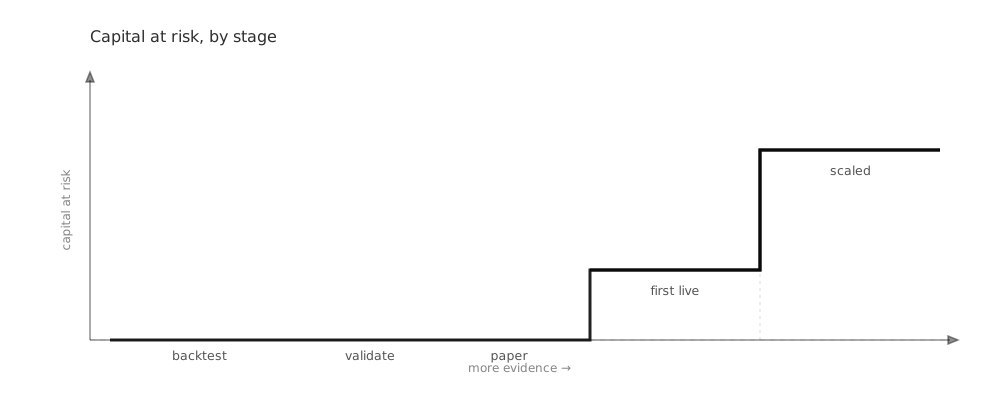
Figure 2: Commit capital in proportion to evidence. Exposure stays low until a strategy has proven itself live, then scales gradually. Illustrative.
Capital should rise with evidence, not ahead of it.Common beginner mistakes
Most beginners fail in the same few ways, and each has a simple correction.
| Common mistake | Better approach |
|---|---|
| Going live too early | Backtest, validate, and paper trade first |
| Piling on indicators | Start with one simple, explainable rule |
| Trusting one good backtest | Add out-of-sample, walk-forward, and Monte Carlo checks |
| Ignoring costs and slippage | Include them from the very first test |
| Scaling up too fast | Add capital only after live evidence supports it |
| Rewriting rules after every loss | Review performance in batches, not in the heat of a drawdown |
None of these is exotic. They are the ordinary ways discipline slips, which is why the order of the steps matters as much as the steps themselves.
Where the real work of algo trading sits
Read the eight steps together and the shape of the task is clear. Building and connecting are quick. Testing and validating are slow, and they are where a beginner's effort actually pays off. The order matters as much as the steps: each one earns the right to the next, and skipping the validation in the middle does not remove the risk. It only defers the discovery to the market, at the worst possible time.
That middle stretch is where daZh by Zudora is meant to help. It gives a beginner a no-code way to assemble a strategy and, more to the point, the tools to test it: backtests that account for costs, out-of-sample and walk-forward checks, and Monte Carlo runs, all before any money is committed. Starting algo trading is the easy part. Starting it in an order that protects your capital while you learn is the part worth getting right.
Frequently asked questions
How do I start algo trading?
Begin with one simple rule, backtest it honestly, validate it with out-of-sample and walk-forward checks, paper trade it, and deploy a small size only once the evidence holds up.
Can beginners do algo trading?
Yes, but start with simple rule-based strategies, paper trading, realistic backtests, and small live size. No-code platforms remove the coding barrier, but they do not remove the need to validate the strategy.
Do you need coding to start?
Not necessarily. No-code platforms let a beginner build rule-based strategies visually, so the effort moves from writing software to testing whether the strategy works.
Is algo trading legal?
Yes, when an automated strategy is run through a registered broker and inside the exchange and regulatory framework. SEBI's retail framework makes the broker responsible and requires each algorithm to be registered.
How much money do you need to start?
Start with paper trading, which needs none. When you go live, the size should be small enough that a run of losses does not affect your ability to keep learning.
What is the safest way to start?
Keep the strategy simple, backtest it with realistic costs, validate it, paper trade it, and begin live at a small size that scales only with evidence.
What is the biggest beginner mistake?
Trusting a good-looking backtest without checking whether the edge survives outside the data it was built on.
Disclaimer: daZh is a software platform for building, testing, and managing user-defined trading strategies. It does not provide investment advice, stock recommendations, guaranteed returns, or profit assurance. Backtests are based on historical data and assumptions; actual trading results may differ.
Sources
- SEBI, "Broad Guidelines on Algorithmic Trading", circular CIR/MRD/DP/09/2012, March 30, 2012 (definition of algorithmic trading). https://www.sebi.gov.in/legal/circulars/mar-2012/broad-guidelines-on-algorithmic-trading_22471.html
- CFA Institute, "Backtesting and Simulation", CFA Program refresher reading, 2026 curriculum. https://www.cfainstitute.org/insights/professional-learning/refresher-readings/2026/backtesting-and-simulation
- David H. Bailey, Jonathan M. Borwein, Marcos López de Prado, Qiji Jim Zhu, "Pseudo-Mathematics and Financial Charlatanism: The Effects of Backtest Overfitting on Out-of-Sample Performance", Notices of the American Mathematical Society, 61(5), May 2014. https://papers.ssrn.com/sol3/papers.cfm?abstract_id=2308659
- SEBI, "Safer participation of retail investors in Algorithmic trading", circular SEBI/HO/MIRSD/MIRSD-PoD/P/CIR/2025/0000013, February 4, 2025 (broker-as-principal; unique-identifier registration; white box and black box categories). https://www.sebi.gov.in/legal/circulars/feb-2025/safer-participation-of-retail-investors-in-algorithmic-trading_91614.html
- SEBI, "Extension of timeline for implementation of SEBI Circular dated February 04, 2025 on Safer participation of retail investors in Algorithmic trading", circular SEBI/HO/MIRSD/MIRSD-PoD/P/CIR/2025/132, September 30, 2025 (full applicability from April 1, 2026). https://www.sebi.gov.in/legal/circulars/sep-2025/extension-of-timeline-for-implementation-of-sebi-circular-dated-february-04-2025-on-safer-participation-of-retail-investors-in-algorithmic-trading-_96979.html