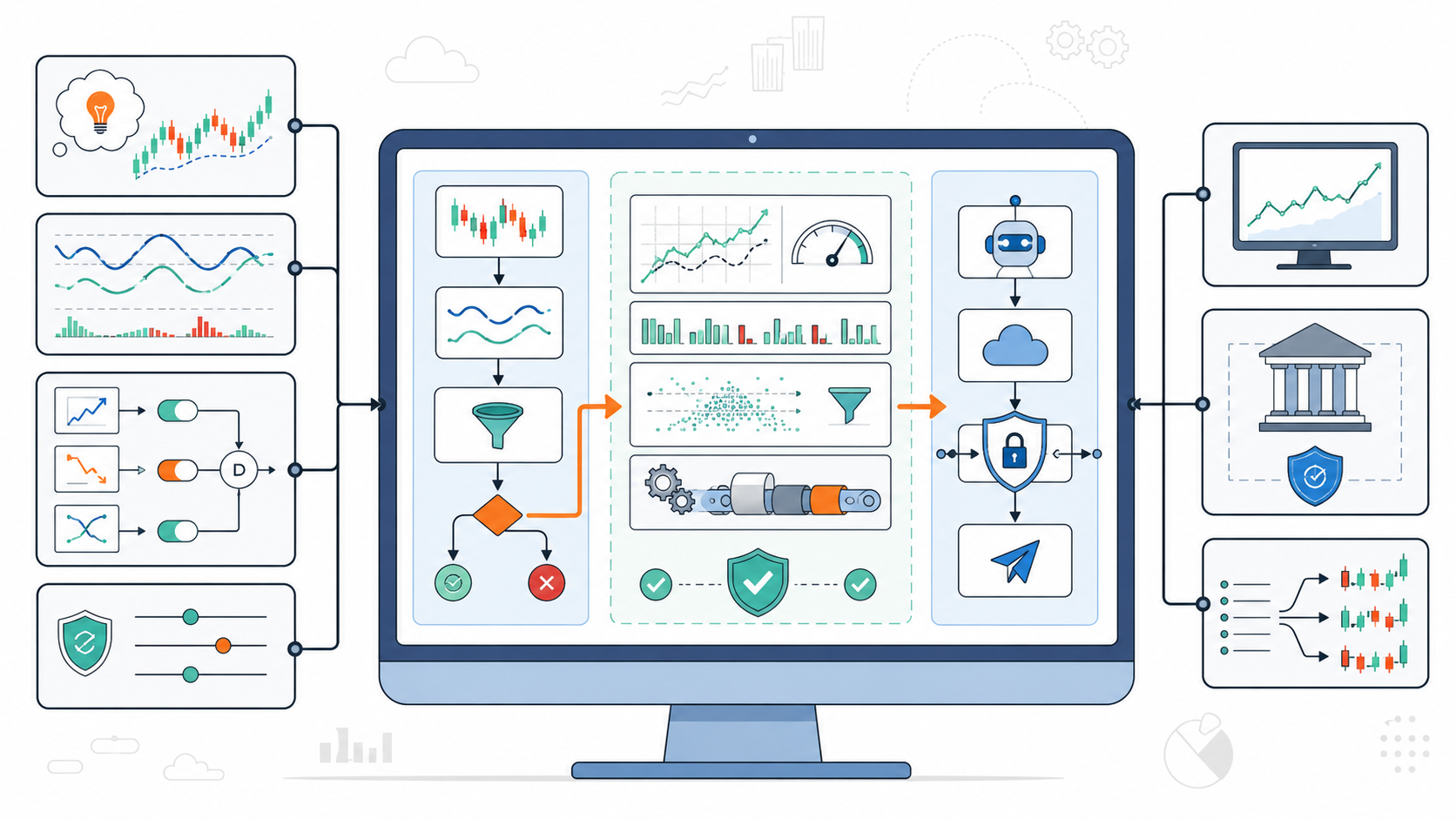
Algo trading, short for algorithmic trading, is trading in which a set of written rules, not a decision made in the moment, decides when to buy and sell. The rules are fixed in advance, a computer checks them against live prices, and an order is placed the instant the conditions are met. The trader's judgement goes into the rules, and the execution then follows them exactly, without hesitation or second-guessing. That discipline is useful only if the rules are worth following.
The markets regulator, SEBI, defines it plainly, as "orders generated using automated execution logic". Once the preserve of institutions, that logic now drives the majority of trading on the exchanges, and the tools to author it no longer require a programmer.
A strategy reaches the market through three stages: build, backtest, deploy. Each is now within a retail trader's reach, which is the real change of the past few years. But the three are not equally hard, and they do not carry equal risk. Building a strategy and connecting it to a broker are the parts the tools have made easy. Whether the strategy is any good is settled in the stage between them, the test against history, and that is the stage that decides whether it survives contact with the market.
Building a strategy and connecting it to a broker are the parts the tools have made easy.What algo trading is
An algorithmic strategy is rule-based, and that is the whole idea. A finished rule set is an explicit list of instructions, with nothing left to discretion once it runs. The trader's judgement is spent once, in writing the rules; from then on the computer applies them the same way every time, on every symbol it is pointed at.
That is the same logic an institutional desk has always used to take emotion out of execution. A rule either triggers or it does not. The strategy does not get tired or talk itself out of a stop loss. Execution discipline, one of the hardest things to hold by hand, is what automation gives almost for free. What it cannot give is a good idea to execute, which is why the rules themselves carry all the risk.
Execution discipline, one of the hardest things to hold by hand, is what automation gives almost for free.What changed is how much of the market now runs on these rules, and who gets to write them. Automated orders made up 53% of cash-market turnover in the first 10 months of FY25, up from 37% in FY15, and close to 70% of notional turnover, the face value of the contracts traded, in equity derivatives, on National Stock Exchange figures. Most of that volume is institutional, but the same automation is now open to a retail trader. Figure 1 shows the shift.
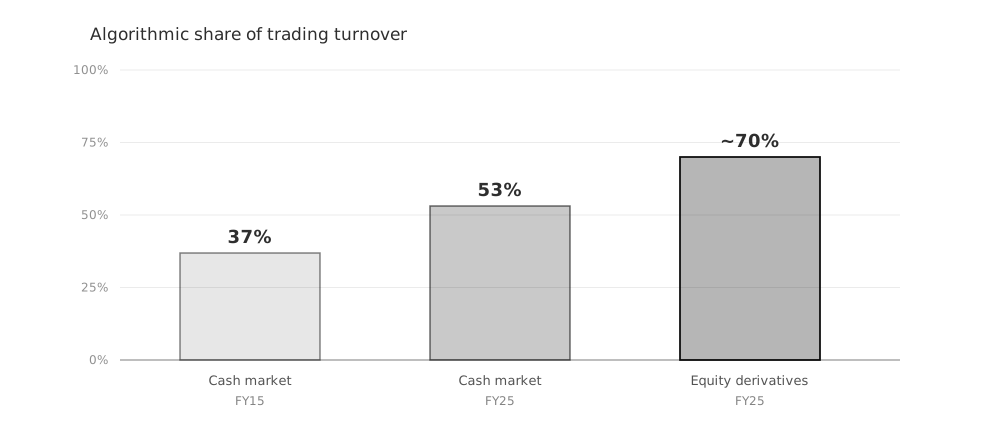
Figure 1: The algorithmic share of turnover, cash market and equity derivatives. Source: National Stock Exchange, Market Pulse, February 2025.
A simple example of algo trading
The difference from manual trading is easiest to see side by side. A discretionary trader reads the chart and decides in the moment; an algorithm acts only when conditions it was given in advance are met.
| Manual trader | Algo strategy |
|---|---|
| Watches a chart and decides whether to enter | Enters only when predefined rules are met |
| May hesitate or act on emotion | Executes the rule exactly as written |
| Can forget a risk rule under pressure | Applies stop-loss, target, and exit rules automatically |
| Reacts to one trade at a time | Can watch many symbols at once |
A rule is just an explicit instruction. A simple one might read: buy when the 20-period moving average crosses above the 50-period moving average, exit if price falls 2%, and close all positions before the market closes. A moving average is an indicator, a calculation derived from price that the rule reads to decide what to do. Once that instruction is written down, the computer applies it identically on every symbol and every day, which is exactly what a person sitting at a screen struggles to do.
Types of algo trading
Algo strategies come in a handful of recognisable forms, each suited to a different market behaviour.
| Type | What it does |
|---|---|
| Trend-following | Trades in the direction of a confirmed price move |
| Mean-reversion | Trades when price moves too far from an average, expecting a return |
| Arbitrage | Tries to exploit price differences across instruments or venues |
| Market-making | Quotes both buy and sell prices to capture the spread |
| Execution | Breaks a large order into smaller ones to reduce market impact |
| Options strategy | Automates multi-leg options entries, exits, and risk rules |
Most retail strategies are variations on the first two. Market-making and pure arbitrage lean on speed and infrastructure that favour institutions. Execution algorithms solve a different problem, getting a large order filled without moving the price against it. Options strategy automation is where multi-leg structures such as spreads and straddles are run by rule rather than placed leg by leg by hand.
The benefits and the risks
Automation changes what a trader has to manage, and it cuts both ways.
| Benefits | Risks |
|---|---|
| Removes hesitation from execution | Bad rules execute bad trades faster |
| Enforces predefined discipline | Overfitting can make a strategy look better than it is |
| Can monitor many symbols at once | Slippage and costs can erase a small edge |
| Makes systematic testing possible | Live results can differ from backtest assumptions |
| Supports steady, measured improvement | Broker and regulatory workflows must be followed |
The risk column has a pattern worth noticing. Automation does not make a strategy good. It makes a strategy faster. That speed helps a sound idea and accelerates a flawed one just as efficiently, so every benefit on the left assumes the rules underneath are worth running. The work that decides an algo strategy is not the building but the testing.
Automation does not make a strategy good. It makes a strategy faster.Is algo trading legal?
Yes. Automated trading is permitted, provided a strategy runs inside the regulatory and broker-supervised framework rather than around it. SEBI, the markets regulator, set out a framework for safer retail participation in algorithmic trading that makes the broker the principal for any algorithm routed through its systems, requires each algorithm to be registered with the exchange and tagged with a unique identifier, and separates white box algorithms, where the logic is visible to the user, from black box ones, where it is not. The framework took full effect on April 1, 2026.
In plain terms, retail algo trading is allowed when it is routed through the required broker-supervised and exchange-registered workflow, subject to the applicable regulatory requirements. What is not permitted is selling unregistered algorithms or marketing assured returns from them. This is a general explanation of the framework, not legal advice; the broker handling the deployment is the right place to confirm the current requirements.
Do you need coding for algo trading?
Traditionally, yes. Running an automated strategy meant writing code, usually Python, wired to a broker's application programming interface, or API, the channel that lets software place orders, with data handling and execution logic to manage alongside it. That assumed the trader could program, which kept algo trading out of most hands.
No-code algo trading changes that. A visual builder lets a trader assemble the same rules through menus instead of code, so the hard part shifts from writing the program to deciding whether the rule deserves capital. A no-code platform such as daZh by Zudora handles the indicators, the signal logic, and the broker wiring, which leaves the trader to focus on the strategy and, more importantly, on testing it. The no-code explainer covers that shift in more depth.
The rest of this piece follows the three stages a strategy moves through before it trades real money. Figure 2 traces the path.
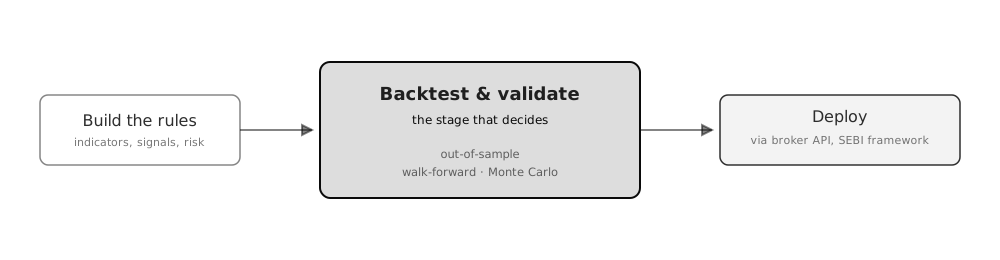
Figure 2: The three stages, with the middle one, where backtesting becomes validation, drawn as the decisive stage.
Stage one, build the rules
Building is where a trading idea becomes an explicit strategy, and it is more than picking an indicator. A complete strategy specifies the entry logic that opens a position, the exit logic that closes it, the position size, the risk limits such as a stop-loss and a cap on the loss it will accept, the instruments it is allowed to trade, and often time filters that keep it to certain hours or hold it back near the close. The indicators are only the inputs those rules read. As the previous section noted, none of this requires code now; a visual builder turns each condition into a selection. What matters is that the rules are written down completely, because everything downstream tests exactly what was specified, and nothing it was not.
Stage two, backtest before you trust
Backtesting is where most of the work sits, and where the real difficulty lives. It runs the finished strategy against historical data to answer one question, which the CFA Institute frames as "how would this strategy have performed if it were implemented in the past". The platform replays past market data through the rules and reports what the strategy would have done: its returns, its worst losing streak, how often it traded. A good backtest is honest about costs and slippage, the gap between the price a rule expects and the price it actually gets, so the result reflects what the strategy would have kept.
A clean backtest is necessary, but it is not proof. The largest danger in algorithmic trading is overfitting, where a strategy fits the quirks of one stretch of history rather than a pattern that will repeat. Bailey, Borwein, López de Prado, and Zhu showed the problem precisely in "Pseudo-Mathematics and Financial Charlatanism", published in the Notices of the American Mathematical Society in 2014: the more strategy configurations a tester tries against the same data, the greater the chance the winning one looks good by luck alone. A flawless equity curve can be the product of a search no one counted.
A flawless equity curve can be the product of a search no one counted.This is why a single backtest is not strategy validation. Validation is the discipline of testing whether an edge holds beyond the data it was tuned on. Out-of-sample testing holds back a slice of history the strategy never saw during tuning, then checks it there. Walk-forward analysis repeats that hold-out across rolling windows, so a strategy has to keep working as the market changes rather than once. Monte Carlo simulation reshuffles the order of trades across thousands of paths to show the range of outcomes luck could have produced.
Each method attacks the same weakness from a different angle, and together they are what separate a disciplined approach to systematic trading from a flattering chart. Building a strategy proves only that it can be expressed. Testing it honestly, past the reach of luck, is what tells a trader whether the idea is worth any capital at all.
Stage three, deploy under supervision
Deployment is the step that used to require code, because the strategy has to reach the exchange through a broker's systems. Once validated, it can be routed for live execution, placing orders by rule rather than by hand, through the broker's API. For years this was closed to most individuals: when SEBI introduced Direct Market Access, the facility to send orders straight to the exchange's systems, in 2008, it was limited to institutional clients.
The 2025 retail framework described earlier opened that door, placing a retail trader's automated strategy inside a defined, supervised structure rather than around the edges of one. Deployment is now a matter of registering the algorithm and routing it through the broker, not of building exchange plumbing from scratch.
The easy stages and the hard one
Across the three stages, the change has been lopsided. A visual builder removed the programming barrier at the first stage. A regulatory framework brought the third stage, live execution through a supervised broker workflow, within retail reach. Both are real. Neither touches the second.
The barrier that fell is the barrier to building and connecting, not the one between a tested idea and a sound one. A strategy that is easy to assemble and easy to route to the market is no likelier to work in it. Whether it holds up is still decided by the honesty of the test in the middle, the part no tool can shortcut.
A strategy that is easy to assemble and easy to route to the market is no likelier to work in it.That is where daZh by Zudora fits. It is a no-code platform built for the stages that decide a strategy before any capital is committed: building it without writing code, then backtesting, optimising, and validating it against history, with walk-forward and Monte Carlo testing, so a trader can see how an idea behaves before trusting it with money. The validation layer between a trading idea and live capital is not the loud part of algorithmic trading. It is the part that decides whether the rest was worth doing.
Frequently asked questions
What is algo trading? Trading in which predefined rules generate and execute orders automatically, with no decision made in the moment. The trader writes the rules; the computer follows them exactly.
Is algo trading legal? Yes, when an automated strategy is run through a registered broker and inside the exchange and regulatory framework. SEBI's retail framework makes the broker responsible, requires each algorithm to be registered, and distinguishes white box from black box algorithms.
Do you need coding for algo trading? Not necessarily. Coding was the traditional route, but no-code platforms let a trader build rule-based strategies visually, which moves the hard part from writing code to validating the strategy.
Does algo trading guarantee profits? No. Automation only executes rules faithfully; it cannot make a weak strategy work. Whether a strategy makes money still depends on the idea and on how honestly it was tested.
What is the biggest risk in algo trading? Trusting an unvalidated strategy because its backtest looked good. A strategy overfit to past data can look excellent in testing and fail in live trading.
Disclaimer: daZh is a software platform for building, testing, and managing user-defined trading strategies. It does not provide investment advice, stock recommendations, guaranteed returns, or profit assurance. Backtests are based on historical data and assumptions; actual trading results may differ.
Sources
- SEBI, "Broad Guidelines on Algorithmic Trading", circular CIR/MRD/DP/09/2012, March 30, 2012 (definition of algorithmic trading). https://www.sebi.gov.in/legal/circulars/mar-2012/broad-guidelines-on-algorithmic-trading_22471.html
- National Stock Exchange, "Market Pulse", Volume 7, Issue 2, February 2025 (algorithmic share of cash-market turnover and equity-derivatives notional turnover). https://nsearchives.nseindia.com/web/sites/default/files/inline-files/Market%20Pulse_February_2025.pdf
- CFA Institute, "Backtesting and Simulation", CFA Program refresher reading, 2026 curriculum. https://www.cfainstitute.org/insights/professional-learning/refresher-readings/2026/backtesting-and-simulation
- David H. Bailey, Jonathan M. Borwein, Marcos López de Prado, Qiji Jim Zhu, "Pseudo-Mathematics and Financial Charlatanism: The Effects of Backtest Overfitting on Out-of-Sample Performance", Notices of the American Mathematical Society, 61(5), May 2014. https://papers.ssrn.com/sol3/papers.cfm?abstract_id=2308659
- SEBI, "Introduction of Direct Market Access facility", circular MRD/DoP/SE/Cir-7/2008, April 3, 2008 (facility initially limited to institutional clients). https://www.sebi.gov.in/legal/circulars/apr-2008/introduction-of-direct-market-access-facility_6465.html
- SEBI, "Safer participation of retail investors in Algorithmic trading", circular SEBI/HO/MIRSD/MIRSD-PoD/P/CIR/2025/0000013, February 4, 2025 (broker-as-principal; unique-identifier registration; white box and black box categories). https://www.sebi.gov.in/legal/circulars/feb-2025/safer-participation-of-retail-investors-in-algorithmic-trading_91614.html
- SEBI, "Extension of timeline for implementation of SEBI Circular dated February 04, 2025 on Safer participation of retail investors in Algorithmic trading", circular SEBI/HO/MIRSD/MIRSD-PoD/P/CIR/2025/132, September 30, 2025 (full applicability from April 1, 2026). https://www.sebi.gov.in/legal/circulars/sep-2025/extension-of-timeline-for-implementation-of-sebi-circular-dated-february-04-2025-on-safer-participation-of-retail-investors-in-algorithmic-trading-_96979.html