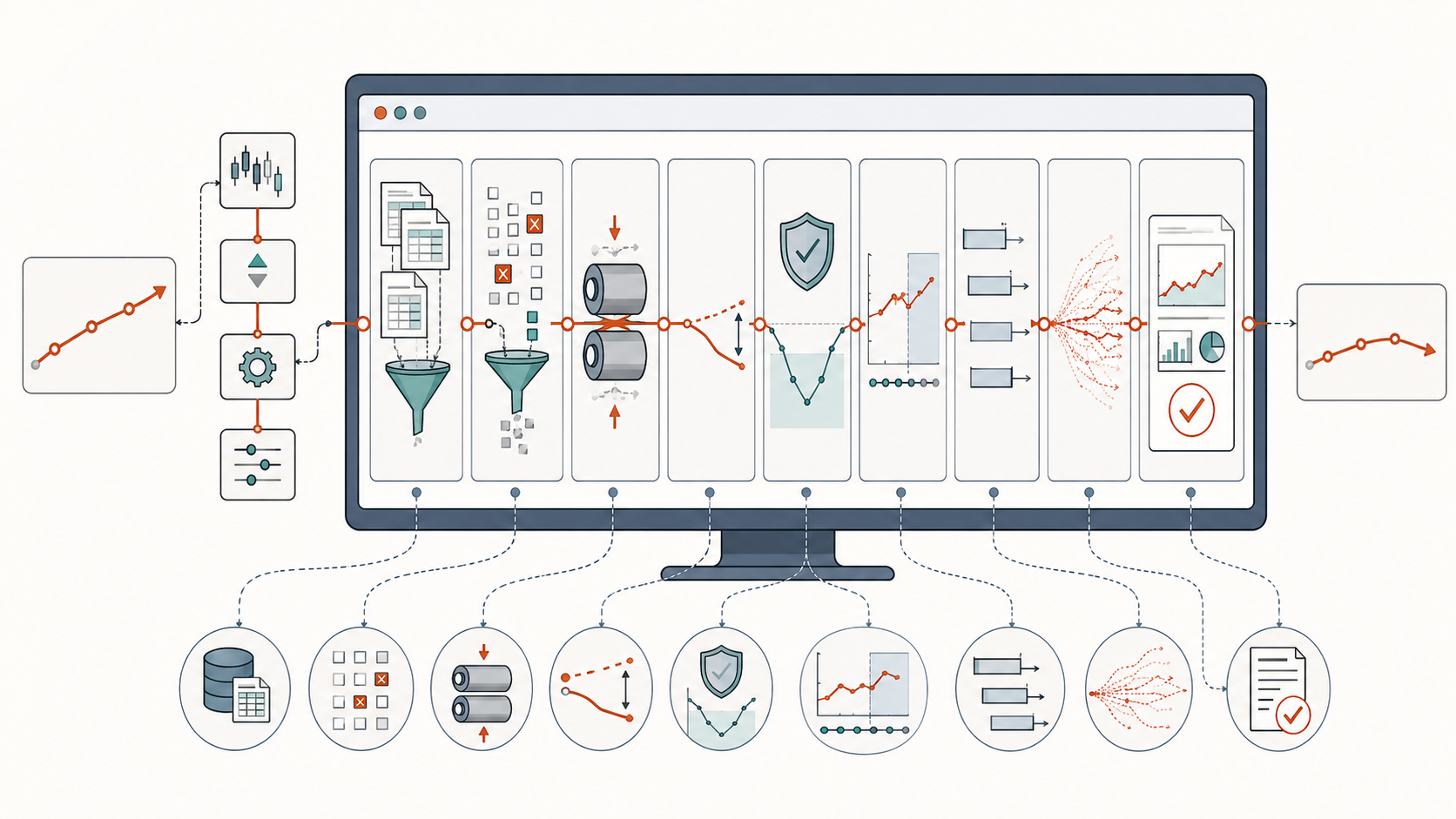
Backtesting software lets a trader test a strategy against historical data before risking any money on it. Every tool in the category promises the same thing: feed it a set of rules, and it will tell you how they would have performed in the past. The catch is that they do not all tell the truth equally well. The same strategy can look brilliant in one tool and ordinary in another, and the difference is rarely the strategy. It is how honestly each tool models reality.
That is the lens this guide uses. The best backtesting software earns its place a different way: it is the one most likely to expose a strategy's flaws before your money does. The whole point of a backtest is to fail on a screen, cheaply, rather than in the market, expensively.
The whole point of a backtest is to fail on a screen, cheaply, rather than in the market, expensively.What backtesting software does
A backtest replays past market data through a fully specified set of rules and reports what they would have done, the question the CFA Institute frames as "how would this strategy have performed if it were implemented in the past". Good software turns that into detail: the return, the worst losing streak, how often it traded, and how it behaved through different market conditions.
That number is a product of the assumptions the software made on your behalf about costs, data, and how orders fill. Change the assumptions and the same idea looks like an edge or a mistake. So evaluating backtesting software really means evaluating how faithfully it models reality. Figure 1 shows what that costs.
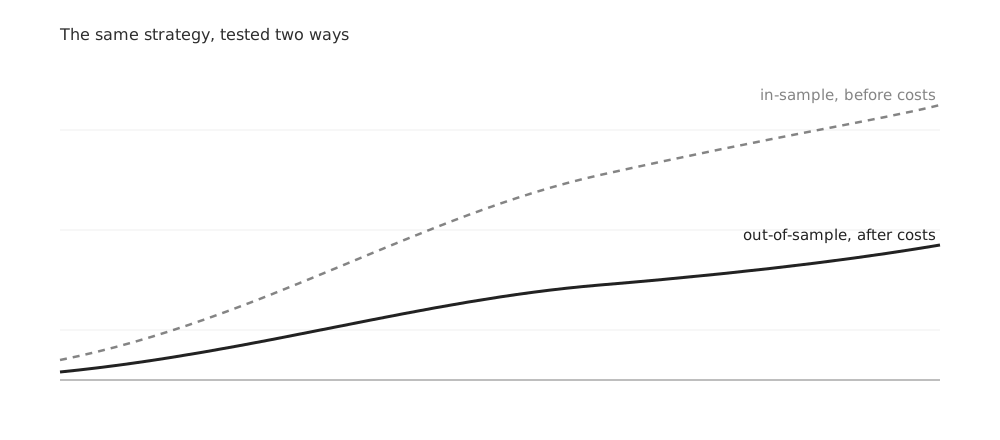
Figure 1: The same strategy, tested two ways. The gap between a gross in-sample curve and an honest after-costs, out-of-sample one is the part of the edge that never reaches the account. Illustrative.
Types of backtesting software
Backtesting tools fall into a few broad categories, and the right one depends on how you trade and how much you can verify yourself.
| Type | Best for | Trade-off |
|---|---|---|
| Spreadsheet-based | Very simple rules and learning the basics | Hard to scale, easy to introduce errors |
| Code-based, usually Python | Developers and quantitative traders | Flexible, but assumes programming skill |
| Broker or platform built-in | Traders already inside that broker's ecosystem | Convenient, but validation depth is often limited |
| No-code backtesting software | Traders who want to build and test visually | Quality depends on how honest the engine is |
| Institutional research platforms | Professional teams and complex strategies | Powerful, but expensive and often overbuilt for retail |
The honesty criteria in this guide apply to all of them. A no-code tool is only as trustworthy as the engine behind the visual builder, which is why the questions that follow matter more than the category label.
Does it model costs honestly
The first thing that separates serious backtesting software from a toy is whether it charges the strategy for trading. Every real trade pays brokerage, taxes, exchange and regulatory fees, and slippage, the gap between the price you aim for and the price a trade actually fills at. A backtest that ignores costs measures an edge you could never capture. The error compounds, because a strategy that trades often can hand its entire paper profit back to costs without the gross curve ever hinting at trouble. The CFA Institute treats realistic transaction-cost assumptions as part of sound trade strategy and execution, not an optional refinement.
So a buyer should ask a blunt question of any tool: does it deduct realistic costs by default, and can you see them? Software that reports only gross returns, or buries costs in a setting that defaults to zero, is making your strategy look better than it is.
A backtest that ignores costs measures an edge you could never capture.Can you trust the data
A backtest is only as good as the history it runs on, and two data problems quietly inflate results. The first is survivorship bias: testing on the instruments that exist today ignores the ones that were delisted or went to zero, so the sample is skewed toward winners. The second is look-ahead bias, where the test accidentally uses information that would not have been available at the moment of the trade, such as a closing price to make a decision that had to be made before the close.
Marcos López de Prado, in Advances in Financial Machine Learning, treats both as central threats to any backtest's credibility. Professional-grade backtesting software should defend against them where possible: point-in-time data, awareness of delisted instruments, and an engine that strictly prevents a rule from reading data from its own future. When you evaluate a tool, ask how far back its history goes, whether it includes instruments that no longer trade, and how it guarantees a rule cannot see ahead.
Validation, not just a backtest
This is the feature that most separates professional backtesting software from the rest, and the one buyers most often overlook. A single backtest, however clean, is not proof. Tune enough rules against the same stretch of history and a strategy will fit its noise, a trap called overfitting. Bailey, Borwein, López de Prado, and Zhu showed in "Pseudo-Mathematics and Financial Charlatanism" that the more configurations you test, the likelier the winner is luck. A tool that lets you sweep hundreds of parameter sets without showing how many you tried is quietly helping you overfit.
Software that takes this seriously builds the defences in, and Figure 2 shows the sequence to look for. Can it reserve an out-of-sample window the tuning never touches, and test there? Can it roll that window forward automatically, so an edge has to survive changing conditions rather than one lucky stretch, instead of leaving you to fake it by hand? Can it resample the trade order in a Monte Carlo run to show how much of the result was luck, or does it report only a single path? A tool that builds these in turns a backtest into strategy validation; one that offers only a single in-sample run leaves the hardest work to you. Even a validated strategy still meets live conditions for the first time in paper trading, not in a backtest, so the strongest tools treat that as the next step rather than the finish line.
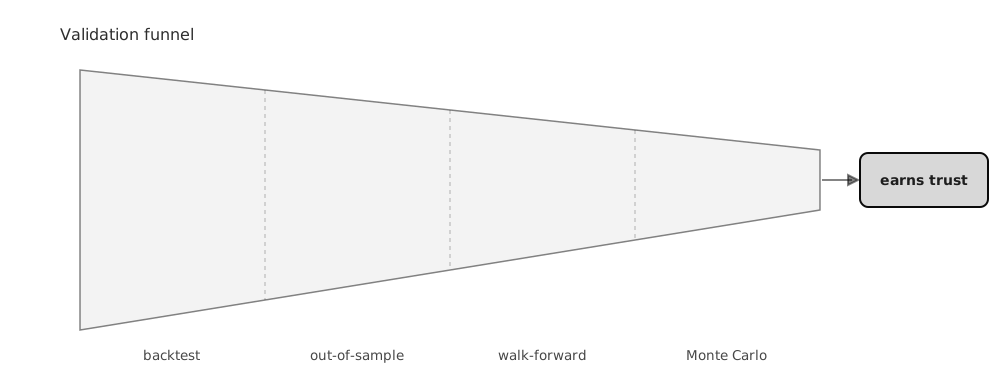
Figure 2: Validation as a funnel. Each stage removes strategies that only looked good in one slice of history; what reaches the end has stronger evidence behind it than a strategy supported by one lucky backtest. Illustrative.
A single backtest, however clean, is not proof.Scope, output, and access
Scope decides what you can actually test. Software limited to one instrument and one timeframe cannot evaluate a strategy that trades a basket, hedges with options, or reads a higher timeframe for context. Multi-asset, multi-timeframe, and options support decide whether the tool can test the strategy you actually want to run.
The report decides what you can see. A tool that shows a single return figure hides the things that decide whether a strategy is survivable. Look for software that surfaces the uncomfortable numbers: maximum drawdown, the largest peak-to-trough fall in the account, the distribution of returns, risk measures, and a full trade-by-trade record, not just the headline.
Access decides who can run the test at all. Backtesting once meant writing code, usually in Python. No-code tools now let a trader express the same rules visually, which widens who can test an idea without lowering the bar for how rigorously it is tested. The platform-level version of this decision, covering live deployment and brokers as well as testing, is its own question, covered in how to choose an algo trading platform.
What to look for: must-haves and nice-to-haves
Not every feature carries equal weight. Sort them before you compare tools.
| Feature | Priority | Why it matters |
|---|---|---|
| Costs and slippage modelling | Must-have | Stops gross returns from overstating the edge |
| Clean historical data | Must-have | Avoids biased or misleading results |
| No look-ahead leakage | Must-have | Prevents a strategy from reading the future |
| Trade-by-trade report | Must-have | Lets you audit exactly what happened |
| Drawdown and risk metrics | Must-have | Shows whether the strategy is survivable |
| Out-of-sample testing | Must-have for serious use | Tests whether the edge survives unseen data |
| Walk-forward testing | Advanced must-have | Checks whether the edge survives re-optimisation |
| Monte Carlo simulation | Advanced must-have | Probes path luck and tail risk |
| Large indicator library | Nice-to-have | Useful, but secondary to honest testing |
| Polished charts | Nice-to-have | Helpful for reading, not a substitute for realism |
The pattern across the list is a single idea. Every feature that matters is one that makes the result harder to fake. A tool that scores well here will sometimes make your strategy look worse, which is exactly what you are paying it to do.
Every feature that matters is one that makes the result harder to fake.Red flags
Some signs should make a buyer dig deeper, or walk away.
| Red flag | Why it is dangerous |
|---|---|
| Costs default to zero | Makes active strategies look better than they are |
| Only gross returns shown | Hides the gap between a paper edge and a tradable one |
| No out-of-sample testing | Encourages overfitting to one stretch of history |
| No trade-level audit | Makes unrealistic fills impossible to spot |
| No drawdown reporting | Hides whether the strategy is survivable |
| No slippage settings | Assumes every order fills at the expected price |
| Marketing that leads with indicator count | Sells complexity instead of validation |
Most of these share a root: the tool is built to make strategies look good, not to test them honestly.
A worked example
The difference between a naive and an honest test is easiest to see on one strategy, run both ways.
| Assumption | Naive backtest | Honest backtest |
|---|---|---|
| Brokerage and taxes | Ignored | Included |
| Slippage | Zero | Added per trade |
| Data | Current symbols only | Point-in-time universe |
| Testing | In-sample only | Out-of-sample and walk-forward |
| Result | A smooth, high headline return | Lower return, deeper drawdown, a more realistic edge |
Illustrative.
The honest version looks worse, and that is the point. It is more valuable because it is closer to the result a trader could actually have experienced, not the one the software was flattered into showing.
Where the real value sits
Buyers tend to choose backtesting software on the size of its indicator library or the polish of its charts. Those are easy to compare and rarely the thing that fails you. What fails you is a tool that lets a flawed strategy look good long enough to fund it. The features that prevent that, realistic costs, data you can trust, and validation that survives more than one slice of history, are less visible and far more valuable.
That is the layer daZh by Zudora is built around: a no-code platform for testing a strategy in depth before any capital is committed, with walk-forward and Monte Carlo validation, parameter optimisation, and analytics that lead with drawdown and risk rather than the headline return. Good backtesting software does not promise the next trade. It tells you, as honestly as software can, whether an idea has earned the right to be tried.
Frequently asked questions
What is backtesting software?
A tool that replays a fully specified trading strategy against historical market data and reports how it would have performed, including its returns, drawdowns, and trade history.
What makes a backtest reliable?
Realistic trading costs, clean point-in-time data, no look-ahead leakage, and validation beyond a single in-sample run, namely out-of-sample, walk-forward, and Monte Carlo testing.
Is free backtesting software good enough?
It can be, if it deducts costs, uses trustworthy data, and supports validation. Many free tools report only gross, in-sample results, which flatter a strategy and hide its real risk.
Do you need to code to backtest a strategy?
No longer. No-code platforms let a trader build and test rules visually, so the effort shifts from writing software to judging whether the strategy holds up.
What is the most common backtesting mistake?
Trusting a single, good-looking in-sample backtest. Without out-of-sample and walk-forward checks, an overfit strategy can look excellent and still fail live.
Disclaimer: daZh is a software platform for building, testing, and managing user-defined trading strategies. It does not provide investment advice, stock recommendations, guaranteed returns, or profit assurance. Backtests are based on historical data and assumptions; actual trading results may differ.
Sources
- CFA Institute, "Backtesting and Simulation", CFA Program refresher reading, 2026 curriculum. https://www.cfainstitute.org/insights/professional-learning/refresher-readings/2026/backtesting-and-simulation
- CFA Institute, "Trade Strategy and Execution", CFA Program Level III refresher reading, 2026 curriculum. https://www.cfainstitute.org/insights/professional-learning/refresher-readings/2026/trade-strategy-execution
- David H. Bailey, Jonathan M. Borwein, Marcos López de Prado, Qiji Jim Zhu, "Pseudo-Mathematics and Financial Charlatanism: The Effects of Backtest Overfitting on Out-of-Sample Performance", Notices of the American Mathematical Society, 61(5), May 2014. https://papers.ssrn.com/sol3/papers.cfm?abstract_id=2308659
- Marcos López de Prado, "Advances in Financial Machine Learning", Wiley, 2018 (survivorship and look-ahead bias; backtesting through cross-validation). https://www.wiley.com/en-us/Advances+in+Financial+Machine+Learning-p-9781119482086