
A good-looking backtest is the easiest thing in the world to produce. Try enough variations of a strategy against the same stretch of history, and one of them is bound to look brilliant, by luck alone. The hard part, the part that decides whether automated trading actually works for you, is telling a real edge from a flattered one, before any money is at stake. That is the work the best algo trading platform has to make possible.
That work matters more as automation becomes ordinary. Algorithmic orders have grown to about 53% of cash-market turnover in the first ten months of FY25, and roughly 70% of equity-derivatives notional turnover (the face value of the contracts traded), according to the National Stock Exchange. As more of the market runs on automated rules, the gap between a tested strategy and an untested one stops being academic.
What follows sets out what serious validation of a strategy involves, how a no-code platform can deliver it, and how the main tools available today line up. daZh by Zudora is built around this layer, the work between a trading idea and live capital, and runs through as the worked example.
The three jobs: build, validate, deploy
An algo trading platform does three jobs: it helps you build a strategy, validate it, and deploy it. Building means turning an idea into explicit rules, entries, exits, sizing, and risk. Deploying means routing the resulting orders to a broker. Both are well understood, and both are largely solved.
Validation is the third job, and it is the one that determines whether the first two were worth doing. It is the work of testing whether a set of rules actually had an edge, and whether that edge would survive outside the slice of history it was built on. A strategy that has not been validated honestly is an idea with an order route attached. Placing an automated order is the easy part. Knowing the strategy deserves to run is the harder one.
Placing an automated order is the easy part. Knowing the strategy deserves to run is the harder one.Build: a strategy without code
A no-code builder turns a market idea into explicit rules without a programming language, so the person with the idea can build it. That is the shift no-code algo trading made: the rules come from menus and clicks, not code, and a strategy stops being the preserve of people who can program.
In daZh, a strategy is assembled from modular blocks: indicators, then signals, then rules. A searchable indicator library feeds configurable signals, threshold triggers, moving-average crossovers, breakouts, pattern and divergence checks, which feed entry, exit, end-of-day, and time-filter rules. Strategies are not limited to a single instrument on a single timeframe; daZh supports multiple timeframes in one strategy and multi-symbol, weighted baskets for spread and pairs work. For options, a leg configurator handles strike selection by at-the-money offset, by delta, or by a fixed strike, with weekly or monthly expiry and rollover, so the strategy follows the right contract without manual reselection each cycle.
A builder decides how fast you can create a strategy. Validation decides whether you should trust it.None of this requires code. What it requires, and what no builder removes, is a clear idea expressed as precise rules. A builder decides how fast you can create a strategy. Validation decides whether you should trust it. The visual layer lowers the cost of trying, but it does not lower the bar the strategy then has to clear. Figure 1 shows the full path that follows, from a visual build through validation to deployment.
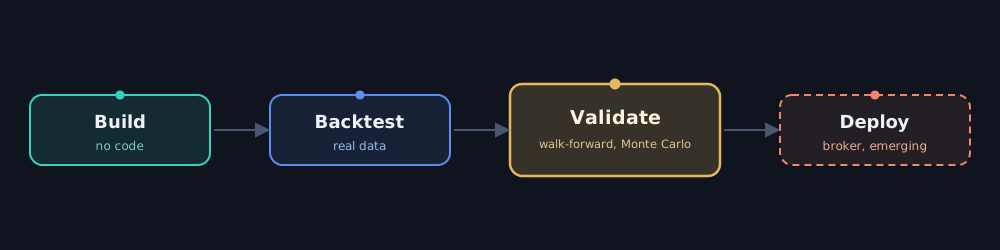
Figure 1: The workflow a strategy moves through, from a visual build to validation to deployment.
Validate: proving the edge is real
Validation is a sequence, not a single test, and each step removes a different way of being wrong.
It begins with a backtest that reflects reality, run on real historical data and realistic assumptions about how orders would actually have filled, so the result describes something that could have happened rather than an idealized run.
A clean backtest is necessary but not sufficient, because a single pass over history can be overfit, tuned to the noise of one fixed past rather than any durable signal. Bailey, López de Prado and colleagues showed that a handful of strategy variations tried against the same data can produce a backtest that looks excellent purely by chance.
The defences against it are specific. Walk-forward validation re-tests a strategy on rolling windows it was never tuned on, the closest a backtest comes to asking how the rules would have held up as conditions changed. Monte Carlo resampling stress-tests the result across thousands of reordered paths, so a curve that depended on one lucky sequence is exposed.
daZh runs both, alongside parameter optimization, as part of the core workflow. Walk-forward and Monte Carlo are how a backtest stops being a story about the past.
Walk-forward and Monte Carlo are how a backtest stops being a story about the past.The same sequence can be driven by a machine-learning model that a non-programmer configures through a form. Inside daZh, a model (decision-tree methods such as XGBoost, LightGBM, or a random forest, which learn patterns from labelled examples) is trained without code: labelling, feature selection, train and test windows, and hyperparameters are all set in the interface, and the trained model drives the strategy's signals. That is the kind of tool that has, until now, belonged to the institutional quant desk.
Taken together, the backtest, walk-forward, and Monte Carlo form one sequence a strategy passes before live capital, and Figure 2 lays it out. Among the platforms compared here, daZh is positioned around a combination that is still uncommon in no-code retail tools: walk-forward validation, Monte Carlo testing, and no-code model training. Serious validation, made usable without code, is what daZh is built around.
Serious validation, made usable without code, is what daZh is built around.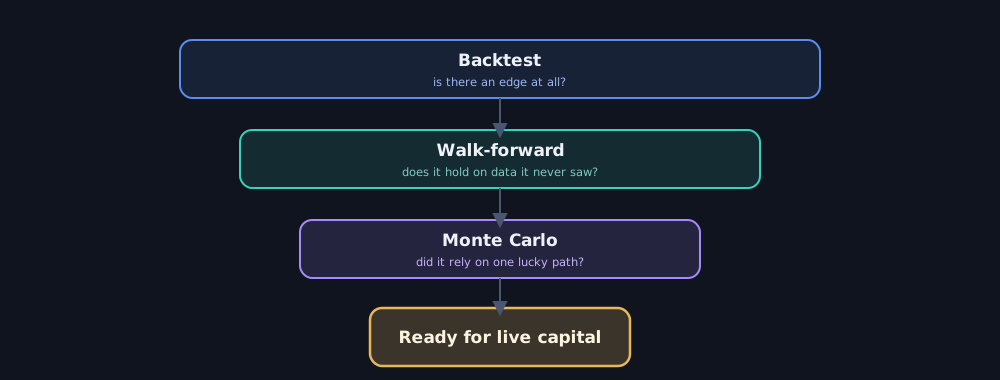
Figure 2: Validation as a sequence. Each stage removes a different doubt before any capital is committed.
Deploy: risk controls and the road to live
Validation only counts if the live strategy is held to the limits it was tested under. daZh surfaces risk as first-class settings rather than buried conditions: maximum drawdown, maximum daily loss, position and exposure limits, and stop-loss and take-profit on an absolute, percentage, or trailing basis. These are the guardrails that keep a deployed strategy inside the envelope its backtest assumed.
A word on where daZh itself stands. Its backtesting and optimization are live today; supervised live deployment, routed through a broker under the retail algo framework now in effect, is being rolled out after them. The validation work comes first, and the live layer is built on top of it.
Where the main platforms fit
No single platform is best at everything; the table is about fit. It sets daZh against the most-used tools on the axes that decide trust, with each platform's strength stated plainly.
The comparison below is based on publicly available product pages as of June 2026. It focuses on validation depth, no-code usability, live automation, and model-building capabilities. Product features change frequently, so traders should confirm current specifications directly before choosing a platform.
| Platform | Build interface | Backtesting | Walk-forward / Monte Carlo | In-platform ML | Live automation | Best for |
|---|---|---|---|---|---|---|
| daZh | No-code blocks: indicators, signals, rules | Multi-timeframe, multi-asset, options-aware | Both | Yes, no-code | Emerging, broker-routed | Validating a strategy in depth without code |
| AlgoTest | No-code, options-focused | 7+ yrs options data | Monte Carlo only | No | Yes, mature | Options backtesting and execution |
| Quantman | No-code, basic and advanced modes | Several years, multi-timeframe | Neither | No | Yes | F&O automation with multi-case testing |
| Tradetron | No-code plus formula layer | Standard, beta engine | Neither | No | Yes | Multi-leg automation and a strategy marketplace |
| AlgoBulls | No-code, AI, and full Python | Event-driven, custom in code | Neither | Yes, code only | Yes | Coders and white-label or enterprise desks |
| Zerodha Streak | No-code, drag-and-drop | About five years | Neither | No | Semi-automated, alerts | Beginners, tightly tied to Zerodha |
| uTrade Algos | No-code plus AI builder | Depth not disclosed | Claimed, not documented | AI assist, no model training | Yes | Options with payoff-curve visualization |
| StockMock | No-code, options-focused | Since about 2020 | Neither | No | None, research only | Options backtesting and research |
Compiled from each platform's public product pages, June 2026.
Read across the row that matters to you. If you are starting out and trade through one broker, a simple drag-and-drop tool removes friction. If you live in index options, an options-native backtester with a payoff chart and a margin calculator will feel purpose-built. If you write Python, a platform that lets you bring your own code and your own models is the natural home. Each of those is a reasonable answer to a specific need. The best platform is the one that earns the decision to go live.
The best platform is the one that earns the decision to go live.What is harder to find in one place is depth of validation made usable without code. Walk-forward testing, Monte Carlo resampling, and a no-code path to machine learning rarely sit together in one no-code tool, as the table above shows. That combination is where daZh sits, the place a strategy is examined before it is trusted.
The useful question is which platform resolves the most doubt before your capital does. A platform that lets you build quickly has saved you an afternoon. A platform that lets you validate has saved you from the costliest way to learn a strategy was flawed, which is in live trading. That gap, between an idea that looks good and one ready for live capital, is where daZh by Zudora is built to work. It is a no-code platform organized around the validation layer between a systematic trading idea and the decision to deploy it.
Disclaimer: daZh is a software platform for building, testing, and managing user-defined trading strategies. It does not provide investment advice, stock recommendations, guaranteed returns, or profit assurance. Backtests are based on historical data and assumptions; actual trading results may differ. Platform comparisons reflect publicly available information as of June 2026 and may change.
Sources
- National Stock Exchange, "Market Pulse", Volume 7, Issue 2, February 2025 (algorithmic share of cash-market turnover and equity-derivatives notional turnover). https://nsearchives.nseindia.com/web/sites/default/files/inline-files/Market%20Pulse_February_2025.pdf
- CFA Institute, "Backtesting and Simulation", 2026 curriculum refresher reading. https://www.cfainstitute.org/insights/professional-learning/refresher-readings/2026/backtesting-and-simulation
- David H. Bailey, Jonathan M. Borwein, Marcos López de Prado, Qiji Jim Zhu, "Pseudo-Mathematics and Financial Charlatanism: The Effects of Backtest Overfitting on Out-of-Sample Performance", Notices of the American Mathematical Society, May 2014. https://papers.ssrn.com/sol3/papers.cfm?abstract_id=2308659
- Zerodha, "Introducing Streak v4", Z-Connect, accessed June 25, 2026 (build modes, semi-automated alerts, risk parameters). https://zerodha.com/z-connect/streak/introducing-streak-v4
- Tradetron, "Pricing" and "Features", accessed June 25, 2026 (no-code plus formula builder, automation modes, broker count, marketplace). https://tradetron.tech/pages/pricing
- Quantman, "Plans and Quota", accessed June 25, 2026 (modes, backtest and live credits, multi-case feature). https://www.quantman.in/faq/plansAndQuota/
- AlgoBulls, "Phoenix" build products, accessed June 25, 2026 (Classic, Copilot, Python build; code-only ML; automation; white-label). https://algobulls.com/phoenix
- AlgoTest, "Option Strategy Builder" and pricing docs, accessed June 25, 2026 (options data depth, Greeks, Monte Carlo, live execution). https://algotest.in/blog/option-strategy-builder-algotest/
- uTrade Algos, "Pricing" and "Backtesting", accessed June 25, 2026 (no-code plus AI builder, payoff curves, automation, trial). https://www.utradealgos.com/pricing
- StockMock, "Strategy Builder", accessed June 25, 2026 (options backtesting and simulation, no live execution). https://www.stockmock.in/strategy-builder.html